
Reviewed · SANTA TERESA TOURS
Centro Historico and Lapa – Santa Teresa Walking, Historical and Bohemian Tour
Rio’s past comes into focus on this long walking tour, which links grand civic buildings, Baroque churches, old cafés, street art, Santa Teresa’s yellow tram, and Lapa’s famous arches. Guide Ivan leads the day, explaining how the center, hills, churches, and waterfront fit together.
I like the small group limit of 12, which gives the guide room to explain details without turning every stop into a herd. I also like the route’s variety: the Metropolitan Cathedral and São Bento Monastery feel formal and historic, while Santa Teresa and Lapa bring street life, murals, views, and a famous tram ride.
The main drawback is the pace. Seven to eight hours of walking, standing, and sightseeing is a full day, and lunch is not included. The non-refundable booking policy also means you should be sure of your plans before paying.
In This Review
- Key points to know before booking
- Starting at Cinelândia, where Rio puts on a grand face
- Inside the Cathedral of Saint Sebastian
- Largo da Carioca and two remarkable churches
- Old pedestrian streets and Confeitaria Colombo
- Praça Quinze and Rio’s imperial waterfront
- Praça Pio X, Candelária, and the Olympic Boulevard
- São Bento Monastery, a quiet change of pace
- Mauá Square and Rio’s modern cultural face
- Etnias mural, a huge burst of public art
- Riding the famous yellow tram to Santa Teresa
- Largo dos Guimarães and the character of Santa Teresa
- Parque das Ruínas and the best views of the day
- Selarón Steps and Lapa’s famous arches
- What the $137.80 price buys you
- Who will enjoy this full-day Rio route?
- Should you book the Centro Histórico, Santa Teresa, and Lapa tour?
- FAQ
- Where does the tour start?
- Where does the tour end?
- How long does the tour last?
- What neighborhoods does the tour visit?
- Is the Santa Teresa tram ride included?
- Is lunch included?
- What drink is included?
- How large is the group?
Key points to know before booking
- Fourteen stops connect Rio’s old center with Santa Teresa and Lapa, so you see much more than a single historic square.
- The yellow Santa Teresa tram ride lasts about 30 minutes, with time built in for the station and the full tram segment.
- Ivan is the guide named in the tour feedback, and his storytelling about Rio’s past is a central part of the experience.
- Several churches are visited from inside, including the Metropolitan Cathedral and São Bento Monastery.
- The route includes Kobra’s Etnias mural and Selarón Steps, two of Rio’s best-known public art sights.
- A drink is included, but lunch is not, so plan for food during this long day.
Starting at Cinelândia, where Rio puts on a grand face
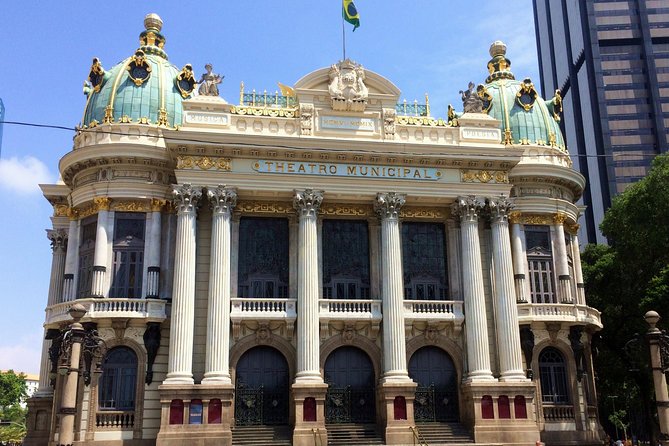
The tour begins at 9 a.m. at the Copacabana Palace, then heads into Rio’s Centro. The meeting point is the hotel at Avenida Atlântica, 1702, and the day ends back there. The route starts at Cinelândia, one of the city center’s most impressive public spaces.
You get about 20 minutes to take in the square and its major buildings. The Teatro Municipal, Rio’s opera house, gives the area a formal European feel. Nearby are the Museu Nacional de Belas Artes, the Câmara Municipal, the Biblioteca Nacional, and the Odeon cinema, the only cinema in the square still operating.
This is a good opening stop because it gives you a quick lesson in how Rio presented itself as a modern capital. You are not just looking at façades. You are seeing the city’s civic, artistic, political, and cultural institutions gathered around one plaza.
The time is short, so do not expect interior visits to every building. The value here comes from Ivan’s explanation and from seeing how the buildings relate to one another.
More samba shows in Rio de Janeiro:
- Rio de Janeiro: Beginner Samba Lesson in Ipanema
★ 4.9 · 1,071 reviews - Rio: Pub Crawl in Lapa with Cachaça Tasting and Live Samba
★ 4.7 · 881 reviews - Rio: Carnival Backstage Tour at Samba City with Cocktail
★ 4.6 · 520 reviews
Inside the Cathedral of Saint Sebastian
A short visit to the Metropolitan Cathedral of Saint Sebastian follows. The tour allows about 15 minutes inside, enough to appreciate the building’s unusual modern form and its tall stained-glass windows.
The cathedral is a sharp change from the grand classical buildings of Cinelândia. Its design and monumental colored glass create a very different mood from the churches later in the day. That contrast is part of what makes the route work. Rio’s religious architecture is not one-style-fits-all.
Admission is free. You will be standing and looking upward, so this is a place where a guide’s explanation helps you notice more than the broad shape of the building.
Largo da Carioca and two remarkable churches
At Largo da Carioca, the tour turns toward two churches beside one another: Santo Antônio and São Francisco da Penitência. You have about 25 minutes here, including the panoramic view from the terrace.
São Francisco da Penitência is especially important for its Baroque decoration. The ornate interior offers a strong contrast with the clean lines of the cathedral. Santo Antônio adds another layer to the stop, and the terrace gives you a broader view of the pair and the surrounding center.
This is one of the better parts of the tour for anyone who wants church art without spending the whole day inside museums. The admission is included, and the guide puts the buildings into their religious and city setting.
Keep your expectations practical. Twenty-five minutes is enough for a focused visit, not a slow study of every carving and detail. If you enjoy architecture, you may wish you had more time here.
Old pedestrian streets and Confeitaria Colombo
The route then passes through pedestrian streets toward Confeitaria Colombo, one of Rio’s oldest cafés. The stop lasts around 10 minutes and focuses on the café’s Art Deco style and its place in the Centro.
You may find this stop more interesting as an architectural pause than as a meal stop. The schedule does not present it as a long café break, and lunch is not included. Still, the building helps you picture the old center as a place of elegant public cafés, business, politics, and daily city life.
If you want to eat here, confirm the timing with the guide before ordering. Ten minutes can pass quickly, especially with a large menu or a busy counter.
More santa teresa tours in Rio de Janeiro:
- Santa Teresa, Lapa, and Cinelândia with Tram Ride and Selarón Steps
★ 4.5 · 274 reviews - Rio de Janeiro: Historic Rio and Santa Teresa Half-Day Tour
★ 4.4 · 228 reviews - Ancient Rio and Santa Teresa Tour with Hotel pick-up and drop-off
★ 4.5 · 154 reviews - Walking tour of the bohemian neighborhoods of Santa Teresa and Lapa
★ 5.0 · 59 reviews
Praça Quinze and Rio’s imperial waterfront
At Praça Quinze de Novembro, you get about 20 minutes to look at a cluster of important sights. The square takes its name from the proclamation of the Republic, and the tour uses it to explain another major turn in Brazil’s political story.
You will see the Church of Our Lady of Carmel, the Paço Imperial, and the equestrian statue of General Osório. The area also gives you a view toward Ilha Fiscal and the ferry pier for Niterói and Paquetá Island in Guanabara Bay.
This is a useful stop because it links grand buildings with the water. The center is not just a collection of churches and government façades. Its waterfront helped shape Rio’s trade, power, and connections across the bay.
The tour does not include ferry rides or a visit to the islands. You are seeing the piers and the wider setting, not adding another excursion to an already full day.
Praça Pio X, Candelária, and the Olympic Boulevard
The next section moves through pedestrian streets to Praça Pio X. The stop lasts about 15 minutes and brings together the Candelária Church, the Olympic Boulevard, the Centro Cultural Banco do Brasil, and Casa França Brasil.
Candelária is another major church in the center, and its position beside newer cultural spaces shows how Rio’s old core keeps changing around its historic buildings. The Olympic Boulevard adds a modern public corridor, while the two cultural centers point to the city’s arts scene.
You will see these places as part of a walking route rather than sit down for a full museum visit. That is a strength if you want an overview of the district. It is a limitation if you hope to spend hours inside exhibitions.
São Bento Monastery, a quiet change of pace
The São Bento Monastery gets its own visit, with about 15 minutes to see the church and hear its story. It is regarded as one of Rio’s most beautiful churches, and the interior gives you another strong example of ornate religious decoration.
After the open squares and public streets, the monastery can feel like a calmer, more focused stop. Look for the contrast between the plain exterior impression and the decorative interior. This is the kind of place that is easy to pass without a guide, yet much more rewarding when someone explains what you are seeing.
The visit is free, and it is short. If services or site conditions affect access, the exact amount of time inside may vary, so treat the schedule as a guide rather than a guarantee.
Mauá Square and Rio’s modern cultural face
Mauá Square shifts the tone again. The tour spends roughly 20 minutes here, pointing out the Museum of Tomorrow, the Art Museum of Rio, and the square’s panoramic views toward the Niterói Bridge and the bay.
You do not visit the Museum of Tomorrow as part of this tour. The building is presented from the outside, along with the surrounding cultural district. The Art Museum of Rio is noted for its upper terrace, which offers views over Mauá Square, the bridge, and the Museum of Tomorrow, but the tour description does not include a museum admission or a dedicated interior visit.
That distinction matters. You are getting orientation and viewpoints, not a full museum afternoon. I like this part because it shows Rio’s newer public face after so many historic churches and imperial buildings.
Etnias mural, a huge burst of public art
At the Etnias mural, you have about 15 minutes to see Eduardo Kobra’s work. The mural represents five ethnic groups and was created for the Olympic Games. It is considered the largest graffiti mural in the world.
This is a lively visual break in the middle of the history-heavy morning. The scale is the point. Stand back if you can, then look at the faces and colors up close. The mural also makes sense in this part of the city, where old port areas have been given new cultural uses.
The stop is free and brief. You will have time for photographs, but not a long art lecture or an extended walk through the port district.
Riding the famous yellow tram to Santa Teresa
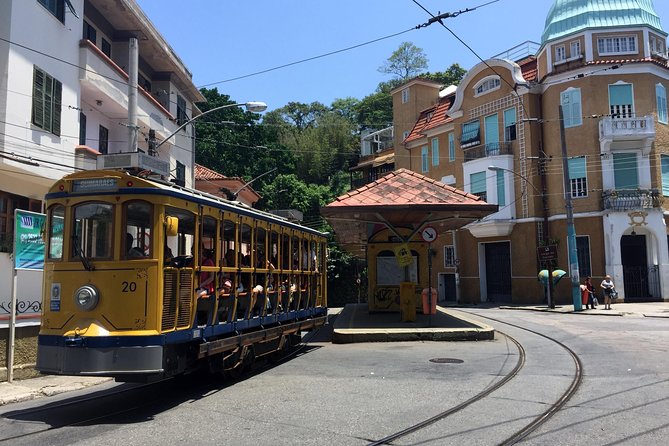
The Santa Teresa tram is the tour’s signature ride. The group returns to the station, then boards the famous yellow Bonde for a panoramic journey up to Santa Teresa. The tram portion is listed at about 45 minutes, with the ride itself lasting roughly 30 minutes.
This is not just a way to avoid a hill. The tram connects the flat historic center with Santa Teresa, a hillside district known for old houses, views, restaurants, and bars. The ride gives you a sense of the city’s shape as the streets rise away from the Centro.
Because the tram is a public attraction and the schedule is approximate, some waiting or timing changes are possible. The ride is included, and it is one of the clearest reasons to choose this route instead of a center-only walking tour.
You will want comfortable shoes for the walking before and after the tram. The day contains repeated stops, uneven city surfaces, and plenty of standing.
Largo dos Guimarães and the character of Santa Teresa
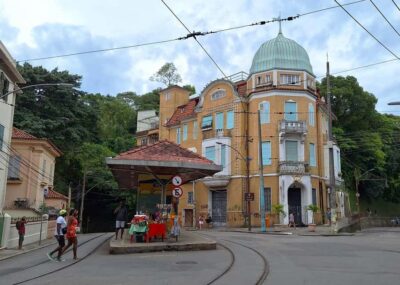
In Santa Teresa, the tour spends about 45 minutes around Largo dos Guimarães. This is the heart of the district, with late nineteenth and early twentieth-century houses, views, restaurants, and bars.
The neighborhood offers a different feel from the formal center. You are looking at residential streets and older buildings rather than grand civic monuments. The guide helps connect the architecture to Santa Teresa’s role as a hillside neighborhood with a distinct identity.
This is a good place to notice the details that a vehicle tour would miss: house fronts, street angles, changing views, and the way businesses gather around a local square. It is also a useful point to ask Ivan about food or drink options, though the tour does not include lunch.
Parque das Ruínas and the best views of the day
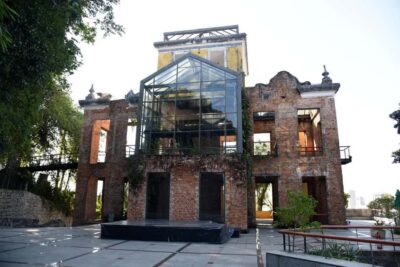
The Centro Cultural Municipal Parque das Ruínas is one of Santa Teresa’s defining stops. The tour allows about 30 minutes at the former home of Laurinda Santos Lobo, now used as a lookout and cultural space.
From here, you can see the Centro, the Lapa Arches, Christ the Redeemer, and Botafogo. The exact visibility of distant sights depends on conditions, but the viewpoint gives you a valuable sense of how Rio’s center, hills, and bay-side districts relate.
This is where the day’s many pieces begin to make visual sense. After walking through streets and squares, you can look down and see the city as a whole. The stop is free, and the time is long enough for photographs and a short explanation without becoming another full museum visit.
Selarón Steps and Lapa’s famous arches
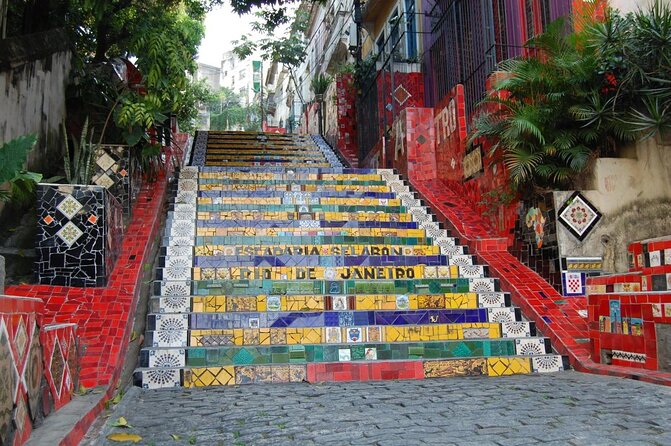
The route leaves Santa Teresa for Lapa and passes the Escadaria Selarón. The staircase was created over about 20 years by Chilean artist Jorge Selarón, who covered it with colorful tiles.
You have around 30 minutes here, giving you time to examine the changing tile patterns and climb enough steps for different views. It is a public artwork, but it is also a real city staircase, so the space can feel more physical and less polished than a gallery.
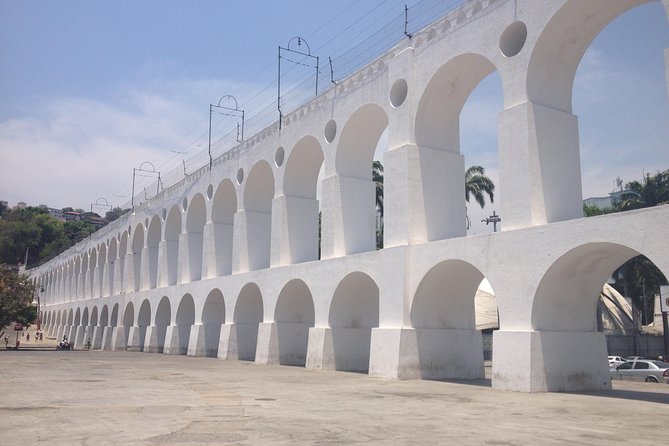
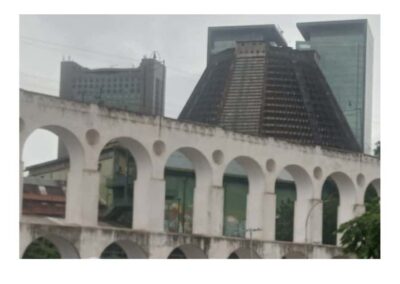
The final stop is the Arcos da Lapa, reached after a walk past graffiti-covered walls. The arches are an eighteenth-century aqueduct that supplied water to Rio until the end of the nineteenth century. Today, the Santa Teresa tram crosses the aqueduct on its way up the hill.
This last pairing is smart. The staircase shows recent, personal street art, while the aqueduct represents older public engineering. Lapa brings the route back to the city’s long story, but with a more informal and artistic mood than Cinelândia.
What the $137.80 price buys you
At $137.80 per person, this is not a cheap city stroll. The value depends on how much you want from a guide-led day rather than how many admission tickets you receive.
Most stops are free, and lunch is not included. You are paying mainly for Ivan’s explanations, the planning across several neighborhoods, the small group of no more than 12 people, and the included Santa Teresa tram ride. You also receive one drink, with a choice of caipirinha, beer, soda, fruit juice, or water.
For a first visit to Rio, the route covers a lot in one day. You do not need to arrange separate visits to the Centro, Santa Teresa, and Lapa, and you get the benefit of moving between them with a clear story. If you prefer long museum visits, spontaneous meals, or a relaxed pace, the price may feel less appealing.
The tour is commonly booked about 18 days ahead, so planning early is sensible. Confirmation is provided at booking, and the experience requires a minimum number of participants. If that minimum is not reached, you are offered another date or experience, or a full refund.
The cancellation rule is strict: the booking is non-refundable and cannot be changed for any reason. Make sure your date is firm.
Who will enjoy this full-day Rio route?
I would choose this tour if you want context, architecture, public art, and city views in one organized day. It suits first-time visitors who want to see beyond Copacabana and Ipanema, as well as repeat visitors who have not yet explored the historic center and Santa Teresa.
It is also a good fit if you prefer a guide who can explain connections between places. Ivan’s role is especially important because the tour moves quickly from opera house to cathedral, from monastery to mural, and from aqueduct to tram.
You should think twice if you dislike walking or need a long lunch break. The day lasts seven to eight hours, includes many short stops, and does not provide lunch. Most people can participate, and public transportation is nearby, but the route still demands ordinary walking stamina.
The tour has a perfect rating from 44 published reviews, with 100 percent recommending it. One detailed French-language note praises Ivan’s ability to explain Rio’s history throughout the day and calls the center a superb discovery. That matches the tour’s strongest feature: a guide who turns separate sights into one readable story.
Should you book the Centro Histórico, Santa Teresa, and Lapa tour?
Book it if you want one packed day that explains Rio’s old center and hillside neighborhoods. The mix is unusually broad: civic buildings, free church visits, Baroque decoration, a historic café, waterfront squares, modern museums viewed from outside, a giant mural, a yellow tram, Santa Teresa streets, Selarón Steps, and the Lapa Arches.
Skip it if your priority is a slow meal, detailed museum time, or a short sightseeing walk. The price is high for a day with mostly free admissions, but the route, tram ride, drink, and small group add practical value.
For the right person, this is a strong introduction to Rio’s history and character. Wear comfortable shoes, keep the morning open, bring money for lunch, and book only when your plans are settled.
FAQ
Where does the tour start?
The tour starts at 9 a.m. at the Copacabana Palace, A Belmond Hotel, at Av. Atlântica, 1702, Copacabana, Rio de Janeiro.
Where does the tour end?
The activity ends back at the meeting point at the Copacabana Palace.
How long does the tour last?
The tour lasts approximately seven to eight hours.
What neighborhoods does the tour visit?
The route covers Rio’s Centro Histórico, Santa Teresa, and Lapa.
Is the Santa Teresa tram ride included?
Yes. The yellow Bonde tram ride is included and takes about 45 minutes in the schedule, with the tram journey itself lasting roughly 30 minutes.
Is lunch included?
No. Lunch is not included.
What drink is included?
You are offered one caipirinha, beer, soda, fruit juice, or water during the tour.
How large is the group?
The tour has a maximum of 12 participants.
More Walking Tours in Rio de Janeiro
- Rio de Janeiro: Rocinha Favela Walking Tour with Local Guide
★ 4.8 · 3,052 reviews - Rio De Janeiro: Half-Day Rocinha Favela Walking Tour
★ 4.7 · 2,272 reviews - Sunrise and Sunrise Walk Two Brothers with Local Guide
★ 5.0 · 193 reviews - Guided Walk to Telegraph Stone
★ 4.5 · 49 reviews
More Historical Tours in Rio de Janeiro
- Rio de Janeiro: Little Africa Heritage Walking Tour
★ 4.9 · 177 reviews - Explore Little Africa : Unveiling Afro Heritage in Rio de Janeiro
★ 5.0 · 97 reviews - Learn the History of Rio with an Unforgettable City Center Walking Tour
★ 5.0 · 82 reviews - Rio’s city walking tour: a glimpse of history and olympic legacy
★ 4.5 · 78 reviews
Just added around Rio de Janeiro
- Vidigal Favela Tour★ 4.4 · 26 reviews
- Hang gliding flight in Rio de Janeiro★ 5.0 · 6 reviews
- Rio de Janeiro: Zip Lining and Canopy Tree Tour★ 3.3 · 6 reviews
- Rio de Janeiro: Attend a Vasco da Gama game with local guide★ 4.8 · 9 reviews
- Unforgettable Boat Party★ 5.0 · 3 reviews
- Tijuca Forest Hike – Waterfalls & Caves, Nature & Wild Life!★ 5.0 · 51 reviews
- Rio Highlights: Christ, Sugarloaf, and More in a Private Tour★ 5.0 · 36 reviews
- Tijuca Forest w/ Chinese View,cascatinha Taunay,horto waterfall and parque laje★ 4.5 · 29 reviews
Santa Teresa Tours, compared.
Santa Teresa, Lapa, and Cinelândia with Tram Ride and Selarón Steps
Read our review →
Ancient Rio and Santa Teresa Tour with Hotel pick-up and drop-off
Read our review →
Walking tour of the bohemian neighborhoods of Santa Teresa and Lapa
Read our review →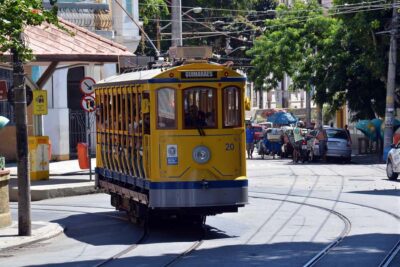
Browse the lists this tour appears in