
Reviewed · HISTORICAL TOURS
Rio’s city walking tour: a glimpse of history and olympic legacy
Rio’s downtown story unfolds in churches, imperial squares, old cafés, market streets, and bold new museums. This walking tour links those pieces in one afternoon, beginning with hotel pickup and ending near the Metropolitan Cathedral and Carioca Square. You get a useful first look at the city beyond Copacabana’s beach.
I like the excellent church interiors, especially São Bento’s gilt carvings and paintings, and I like the chance to see Mauá Square’s Olympic-era renewal alongside much older Portuguese architecture. Guides such as JB, also called Juan Bautista, André, and Melanie have earned praise for clear explanations and flexible pacing. The main caution is that traffic, group arrangements, and guide style can affect how much of the route you walk and how much time you get inside each place.
In This Review
- Key points to know
- Why this tour gives you a useful first look at Rio
- Candelária Church and the waterfront beginning
- São Bento Monastery and the art inside
- Praça XV and the Imperial Palace
- Downtown market streets and Confeitaria Colombo
- The Metropolitan Cathedral and Carioca Square
- How much walking should you expect?
- Is $60.77 a fair price?
- Who will enjoy this Rio walking tour?
- Should you book it?
- FAQ
- How long is Rio’s city walking tour?
- What places are included?
- Is hotel transportation included?
- Is food included in the price?
- How large can the group be?
- What happens if the tour is canceled?
Key points to know
- Old Rio in one afternoon: Link Candelária, São Bento, Praça XV, the Imperial Palace, downtown markets, and the Cathedral.
- São Bento is a major highlight: Look for the ornate chapel, painted panels, and carved details.
- Olympic legacy meets colonial Rio: Mauá Square brings the Museum of Tomorrow, Rio Art Museum, and large Cobra murals into the route.
- Guides can shape the day: JB, André, and Melanie have been praised for history, warmth, and adapting the route to personal interests.
- Hotel transfers save time: Pickup and return are included for most hotels in São Conrado, Leblon, Ipanema, and Copacabana.
- Expect real walking: You should have moderate fitness, though traffic may mean some sections are covered by vehicle.
Why this tour gives you a useful first look at Rio
The route is less about checking off one grand monument and more about learning how central Rio fits together. You move from the waterfront district around Mauá Square through churches, imperial buildings, market streets, old cafés, and major public squares. That makes it especially helpful on your first or second day, when you want a map in your head before setting off alone.
At about four hours, the tour is long enough to provide context without taking your entire day. The published start time is 1 p.m., so you still have the morning for another activity. Hotel pickup also removes one common Rio headache: working out how to reach downtown from the beach districts.
The format can change with the group. The maximum is 35 people, but some departures have had only two or three participants, and some have become private tours. A small group may allow the guide to skip places you have already seen or spend more time on a church, square, or cultural center that catches your interest. A larger group will feel less personal.
The guides are an important part of the experience. JB is described as energetic, fast-moving, and passionate about Rio’s past and present. André has been praised for arriving on time and adjusting the visit to suit individual plans. Melanie, also referred to as Malenia in some accounts, has handled English and Spanish while keeping the group together. Those names matter because the quality of this tour depends heavily on the person leading it.
A few more Rio de Janeiro trips to weigh up
- Rio de Janeiro: Historic Rio and Santa Teresa Half-Day Tour
★ 4.4 · 228 reviews - Rio de Janeiro: Little Africa Heritage Walking Tour
★ 4.9 · 177 reviews - Explore Little Africa : Unveiling Afro Heritage in Rio de Janeiro
★ 5.0 · 97 reviews
Candelária Church and the waterfront beginning
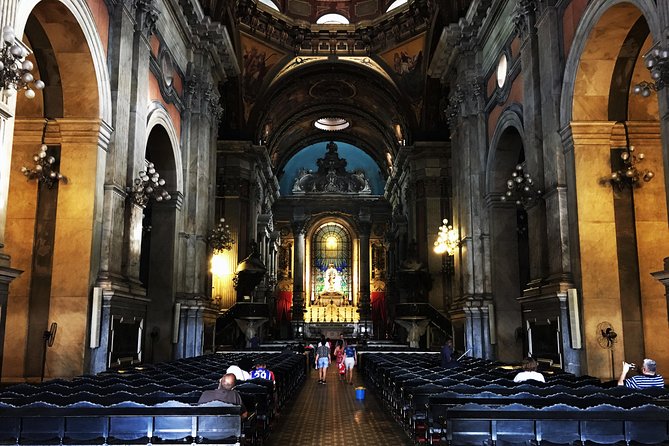
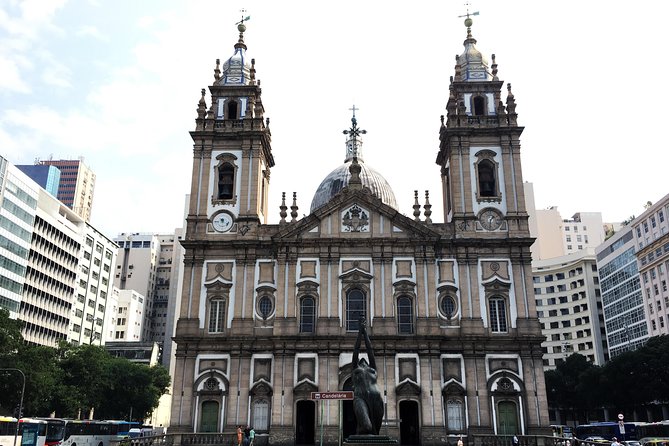
The Church of Our Lady of Candelária is an effective opening stop. Construction began in 1630 and was completed in 1775, and its neoclassical design gives you an immediate sense of Rio’s Portuguese and imperial roots. The visit is scheduled for about 10 minutes, with no separate admission charge.
Ten minutes is enough to look at the main interior, but not enough for a slow architectural study. If you care about church art, listen closely while the guide explains what you are seeing and use any free moment for a quick look upward and toward the altar. This is a working church rather than a museum arranged for visitors, so the pace may depend on access and the day’s conditions.
From there, the route reaches the renewed Mauá Square. This part shows a very different Rio. The square was reshaped as part of the city’s Olympic legacy and now connects several cultural attractions, including the Rio Art Museum, the Museum of Tomorrow, and the large Cobra murals.
The point is not simply to admire new buildings. Mauá Square helps you see how Rio has tried to turn an old port area into a place for art, public gathering, and entertainment. The contrast with the nearby colonial and imperial sites gives the walk its best visual rhythm.
You see the modern Museum of Tomorrow from outside. Depending on time and group movement, you may not go inside, so think of this as an introduction rather than a museum visit. One useful detail from the tour experience is that a guide may help you find a good view of the museum from São Bento Monastery, offering a striking old-and-new photograph.
The route also passes an important cultural center. The exact amount of time here can vary, but the stop adds another layer to downtown Rio’s cultural life. If your main goal is museum interiors, you should plan separate visits. This afternoon is designed to connect the institutions rather than explore them in depth.
São Bento Monastery and the art inside
São Bento Monastery is one of the strongest reasons to book this walk. Founded in 1590 by two monks from Bahia, it is regarded as an important piece of Brazilian architectural heritage. The outside may look restrained, but the interior is known for paintings, gilded woodwork, and elaborate carved decoration.
The scheduled visit is about 10 minutes, which sounds brief for such a detailed place. Still, a short guided stop can work well because the guide directs your attention to the most important features. Look carefully at the decorative carving and painted surfaces instead of rushing through as if this were only another church on a checklist.
Several accounts single out the Benedictine chapel and its artwork. That praise is understandable. São Bento provides the sort of interior that can change your sense of Rio in a few minutes: quiet, ornate, and very different from the open-air image associated with the city’s beaches and mountains.
You may also hear about or visit an old Portuguese library building during the broader downtown route. The library is not listed as one of the four formal timed stops, so you should not treat it as guaranteed. But when included, it has been a major surprise for people who did not know such a place existed. Ask your guide about it if books, architecture, or old interiors interest you.
One caution: religious sites can have access limits, and a 10-minute stop does not leave much room for lingering. The guide’s explanation is valuable, but you may need to return independently if São Bento becomes your favorite place.
Praça XV and the Imperial Palace
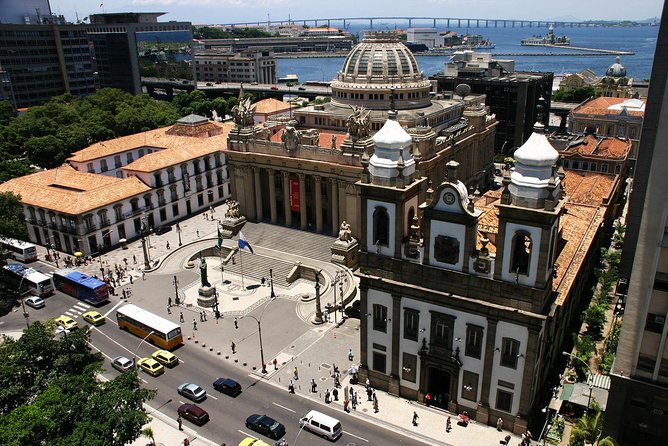
Praça XV do Novembro brings politics and ceremony into the walk. Brazil’s emperors were crowned here in the 1800s, and other major events took place in the square. It is a good place to pause and let the guide explain how Rio functioned as a seat of power.
The Portuguese-style Paço Imperial, or Imperial Palace, adds a physical link to that story. It was built in the 1700s as a residence and workplace for the rulers of Brazil. It later served as the residence of the Portuguese Royal Family when it arrived in Brazil, giving this building a role that reaches beyond local government.
You should expect to view the building and learn about its use rather than spend a long period touring every room. That distinction matters if you are comparing this walk with a palace-focused visit. Here, the palace forms part of a larger chain of places that explains how Rio grew from a colonial port into the capital of an empire.
The route also passes Tiradentes Palace from outside. This adds another important civic building, though the visit is mainly visual. Your guide can help connect the square, palace, churches, and streets into a story that is easier to follow than a series of isolated photographs.
Same city, a completely different kind of day:
- Rio de Janeiro: 6-Stop Highlights of Rio with Lunch
★ 4.4 · 5,157 reviews - Christ the Redeemer Entry Ticket by Corcovado Train
★ 4.4 · 4,476 reviews - Rio de Janeiro: Rocinha Favela Walking Tour with Local Guide
★ 4.8 · 3,052 reviews - Rio de Janeiro: Sugarloaf Cable Car Official Ticket
★ 4.6 · 2,873 reviews
Downtown market streets and Confeitaria Colombo
A stroll through Uruguaiana Street brings you into the everyday commercial side of central Rio. The area is known for market streets, and this is where the tour feels less like a formal monument circuit. You see the working downtown, with shops and street activity replacing grand façades.
That change of mood is useful. Historic buildings tell you about rulers and institutions, but market streets show how the center functions now. Stay aware of your belongings, follow the guide’s lead, and use the walk as a chance to observe rather than rush toward the next landmark.
Confeitaria Colombo is scheduled for about 20 minutes. This famous bakery and café gives the route a welcome pause, and its old-world interior is part of the appeal. It is also a practical place to ask questions and catch your breath.
Food and drinks are not included, so any purchase there is extra. A 20-minute stop is enough to see the room and perhaps order something, but it is not a full meal break. One concern raised about the experience is that a long tea-shop stop can reduce time for other sights. If Colombo matters greatly to you, enjoy it. If you prefer more streets and monuments, tell the guide early that you would rather keep moving.
The café stop also helps explain the tour’s pace. This is not a nonstop march. You get a mix of interiors, open squares, street scenes, and short pauses, though the balance depends on the guide and the group.
The Metropolitan Cathedral and Carioca Square
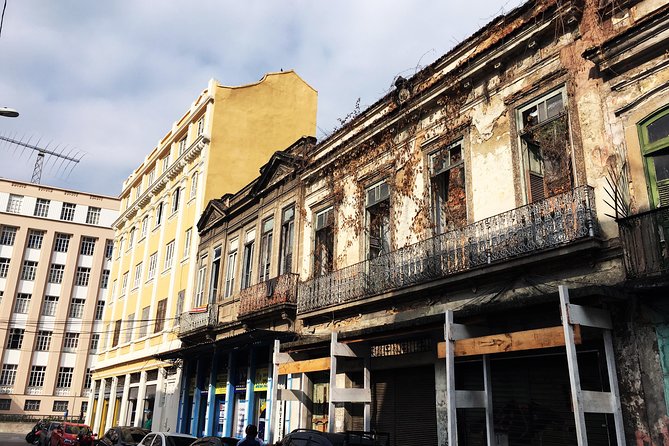
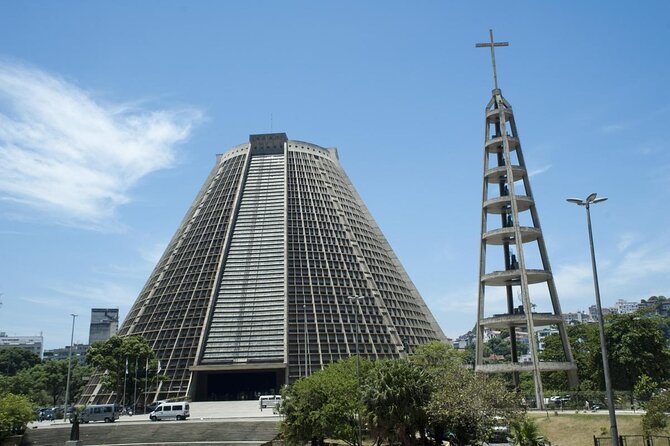
The final major stop is the Metropolitan Cathedral of Saint Sebastian, one of downtown Rio’s most unusual buildings. Its conical form is far removed from the traditional church shapes seen earlier in the day. The interior diameter is given as 96 meters, with an external diameter of 106 meters and an overall height of 75 meters.
Those measurements are not just trivia. They help you understand the scale once you are inside. The vast space and tall structure create a very different mood from São Bento’s dense ornament. The tour allows about 10 minutes here, so look toward the ceiling and stained glass before the group moves on.
The route continues toward Carioca Square, and the tour ends in this central area. The stated route and some experiences vary on the exact finish, so confirm with the guide whether your final stop will be inside the Cathedral, outside it, or one block away. One person found the tour ended just short of the Teatro Municipal and had to continue independently later. That is a useful reminder: ask to see a nearby sight if it is important to you, rather than assuming every downtown landmark is included.
After the tour, you may explore on your own or take the return ride to your hotel. The included return transfer is offered to most hotels in São Conrado, Leblon, Ipanema, and Copacabana. If your lodging is elsewhere, check the arrangement before booking.
How much walking should you expect?
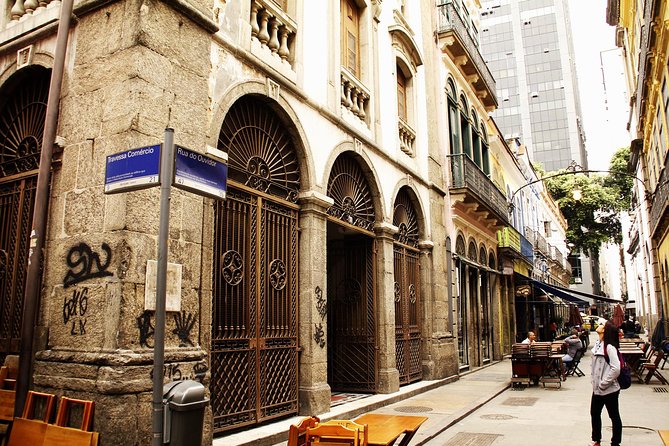
The tour requires moderate physical fitness. You walk between churches, squares, market streets, cafés, and the Cathedral, often on city sidewalks and through central streets. One account described a fast pace and a lot of walking, while another found that heavy traffic led to more driving and less time on foot.
That variation is worth planning for. Wear comfortable shoes, bring water, and avoid treating the four-hour estimate as a guarantee of a fixed walking distance. If you walk slowly or need frequent rests, tell the guide at the start. Some guides have adjusted the time spent at stops, especially when the group was very small.
Traffic can affect the day in another way. The included vehicle transfer is convenient, but downtown traffic may delay pickup or reduce the walking portion. A small number of people have also experienced confusion over the pickup hotel and timing. If you are meeting the guide at a hotel where you are not staying, wait inside the reception area and make sure the guide can find you.
Is $60.77 a fair price?
At $60.77 per person, this is not the cheapest way to walk around central Rio. You are paying for hotel pickup and return, a local guide, and a ready-made route through several historic and cultural areas. For someone staying in Copacabana, Ipanema, Leblon, or São Conrado, the transport alone adds convenience.
The value is strongest when you want orientation, context, and help navigating downtown on your first visit. A guide can point out details you might miss, explain the relationship between imperial sites and modern cultural projects, and offer practical suggestions for later meals, markets, or independent visits.
The price is harder to justify if you mainly want long visits inside museums or churches. Several stops are short, food and drinks cost extra, and some parts are seen from outside. You can also cover portions of the route independently by public transport for less money if you are comfortable planning and navigating on your own.
I would think of this as a guided introduction, not a complete downtown museum day. The tour earns its price when the guide is engaged and the group is small. It offers less value if the guide rushes, spends too much time on a café stop, or focuses only on completing a list of stops.
Who will enjoy this Rio walking tour?
I would recommend it to first-time visitors who want to understand downtown before returning to favorite places alone. It suits people who enjoy architecture, churches, city planning, and stories about Brazil’s imperial period. It is also useful for anyone who wants a local guide’s suggestions for the rest of the trip.
The tour may suit you less if your priority is Rio’s famous beaches, viewpoints, or nightlife. Those are not the focus here. It may also frustrate you if you dislike group pacing or want to spend an hour inside each attraction.
Ask for flexibility if your departure is small. Guides such as JB and André have adapted the route to personal interests, and Melanie has been praised for a warm, easygoing approach. A clear request can help you see more of what matters to you, though no specific extra stop is guaranteed.
The overall rating is 4.3 from 78 ratings, which fits the experience’s character: usually a strong introduction, but not perfectly consistent. The guide makes a real difference. So do traffic, group size, and how much time you want at each stop.
Should you book it?
Book this tour if you want a convenient, guided first afternoon in central Rio, with São Bento Monastery, Candelária, Mauá Square, Praça XV, Confeitaria Colombo, and the Metropolitan Cathedral tied into one route. The mix of imperial buildings, market streets, old cafés, and Olympic-era cultural projects gives you a broader picture than a church-only walk.
Skip it if you want a low-cost self-guided stroll or long museum visits. If you book, choose it early in your stay, wear good walking shoes, ask about the exact pickup point, and tell the guide which places deserve extra time. At its best, this is an informative, flexible introduction to a part of Rio many beach-focused visits overlook.
FAQ
How long is Rio’s city walking tour?
The experience is scheduled to last about four hours, beginning at 1 p.m. Some accounts describe a longer day, so allow extra flexibility around the published duration.
What places are included?
The route includes Candelária Church, São Bento Monastery, Mauá Square, the Museum of Tomorrow from outside, cultural centers, Praça XV do Novembro, the Imperial Palace, downtown market streets, Tiradentes Palace from outside, Confeitaria Colombo, and the Metropolitan Cathedral.
Is hotel transportation included?
Yes. Pickup and return are included for most hotels in São Conrado, Leblon, Ipanema, and Copacabana.
Is food included in the price?
No. Food and drinks are not included. The visit to Confeitaria Colombo lasts about 20 minutes, but anything you order there costs extra.
How large can the group be?
The tour can have a maximum of 35 people. Some departures may be much smaller, and a small group can allow the guide to adjust the pace or route.
What happens if the tour is canceled?
If poor weather causes cancellation, you can receive a different date or a full refund. If the minimum number of participants is not reached, you can also choose a different experience or receive a full refund. You may cancel for a full refund up to 24 hours before the start time.
Just added around Rio de Janeiro
- Vidigal Favela Tour★ 4.4 · 26 reviews
- Hang gliding flight in Rio de Janeiro★ 5.0 · 6 reviews
- Rio de Janeiro: Zip Lining and Canopy Tree Tour★ 3.3 · 6 reviews
- Rio de Janeiro: Attend a Vasco da Gama game with local guide★ 4.8 · 9 reviews
- Unforgettable Boat Party★ 5.0 · 3 reviews
- Tijuca Forest Hike – Waterfalls & Caves, Nature & Wild Life!★ 5.0 · 51 reviews
- Rio Highlights: Christ, Sugarloaf, and More in a Private Tour★ 5.0 · 36 reviews
- Tijuca Forest w/ Chinese View,cascatinha Taunay,horto waterfall and parque laje★ 4.5 · 29 reviews
Historical Tours, compared.

Scenic Train ride to historical cities of Morretes and Antonina
Read our review →

From Foz do Iguazu: Triple Frontier Landmark Ticket
Read our review →
Explore Little Africa : Unveiling Afro Heritage in Rio de Janeiro
Read our review →
Downtown-Center History Walking Tour – in English
Read our review →Browse the lists this tour appears in