
Reviewed · SANTA TERESA TOURS
Walking tour of the bohemian neighborhoods of Santa Teresa and Lapa
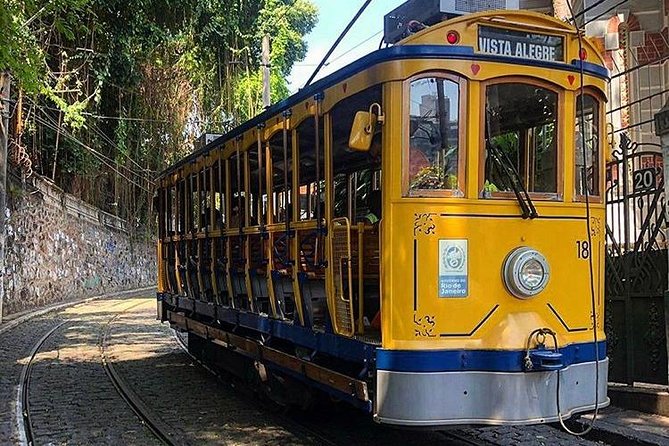
Rio’s old yellow Santa Teresa tram is the star here. It rattles uphill from the city center into a hilltop district of old houses, studios, cafés, and wide views. From there, you walk downhill through Santa Teresa and Lapa, ending among Rio’s grand civic buildings at Cinelândia.
I like two things right away: the route combines several of Rio’s best-known sights without feeling like a checklist, and the small maximum group of 12 gives guides room to adjust the pace. Guides such as Edmundo, Lorena, and Ivan are praised for their warm local connections, with Ivan even being a Santa Teresa resident. The main drawback is that this is a proper walking tour with hills, uneven surfaces, and about three and a half hours on your feet.
In This Review
- Key points to know before booking
- Why this route works so well in Rio
- Riding the yellow tram uphill
- Largo dos Guimarães and the feel of Santa Teresa
- Parque das Ruínas and Rio from above
- Walking down to the Selarón Steps
- The Lapa Arches and street art
- Cinelândia and the grand center of Rio
- What the $72.09 price includes in practical terms
- The guides and the personal side of the tour
- Who should book this walk
- Timing, meeting point, and small details
- Should you book it?
- FAQ
- Where does the tour start?
- What time does the tour begin?
- How long does the tour last?
- What transportation is used?
- How many people can join?
- Does the tour return to the starting point?
- Can I cancel for a refund?
Key points to know before booking
- The tram ride is the scenic opening: Allow about 45 minutes for the station, boarding, and the charming uphill ride.
- Santa Teresa gets the most time: Largo dos Guimarães and Parque das Ruínas show the neighborhood’s old homes, artsy character, and broad views.
- You walk from Santa Teresa into Lapa: The route links the Selarón Steps, Lapa Arches, street art, and Cinelândia.
- Guides make the difference: Edmundo, Lorena, and Ivan are especially noted for personal, flexible guiding.
- It is a small-group morning: The maximum is 12 people, with a 9:00 a.m. start and an advertised duration of about 3 hours 30 minutes.
- The price is $72.09 per person: That is fair if you value transport, local explanation, and a carefully connected route more than independent sightseeing.
Why this route works so well in Rio
Santa Teresa and Lapa sit close together, but they feel like different chapters of Rio. Santa Teresa rises into the hills, with old villas, leafy streets, art spaces, and views toward central Rio. Lapa sits below, known for its huge aqueduct arches, tiled staircase, nightlife, graffiti, and formal city buildings.
I like this tour because it lets you see the change on foot. You begin with the slow climb by tram, explore Santa Teresa at a relaxed pace, then descend toward Lapa. That makes the geography easy to understand. You are not simply driven from sight to sight. You can see how the hilltop district connects with the older center below.
The small group matters, too. With no more than 12 people, you are less likely to be herded through narrow streets or left with only a guide’s prepared speech. Lorena has adjusted plans when tram service was interrupted and offered an alternative when a sight had already been visited. That sort of flexibility is useful in Rio, where transport and city events can change the morning’s rhythm.
More samba shows in Rio de Janeiro:
- Rio de Janeiro: Beginner Samba Lesson in Ipanema
★ 4.9 · 1,071 reviews - Rio: Pub Crawl in Lapa with Cachaça Tasting and Live Samba
★ 4.7 · 881 reviews - Rio: Carnival Backstage Tour at Samba City with Cocktail
★ 4.6 · 520 reviews
Riding the yellow tram uphill
The tour begins at the Santa Teresa tram station, with the ride taking about 30 minutes and the full stop listed at roughly 45 minutes. The famous yellow Bonde is more than a way to get uphill. It is a moving introduction to Santa Teresa.
The tram crosses the Lapa aqueduct before climbing toward the neighborhood. That gives you an immediate sense of the route’s history and odd mix of old and new. Below, you see the large arches and central streets. Above, the city thins into a quieter hill district.
The ride is panoramic, but it is not a private sightseeing vehicle. You should expect a public transport experience, not a polished coach with a running commentary at every turn. That is part of the charm. The tram is old-fashioned, open to the feel of the city, and tied closely to Santa Teresa’s identity.
Service can occasionally be affected by a situation in the neighborhood. The guide may need to adjust the opening plan, so do not treat the tram ride as the only reason to book. If it runs as planned, it is a memorable start. If not, a good guide can still make the walking portion work.
Largo dos Guimarães and the feel of Santa Teresa
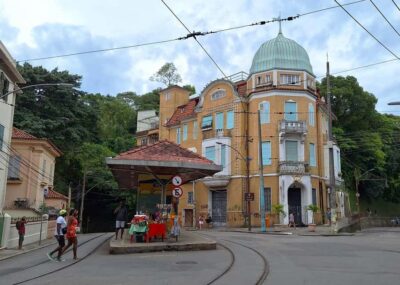
The tour spends about 45 minutes around Largo dos Guimarães, the main meeting place in Santa Teresa. This is where the neighborhood’s character comes into focus.
Look for the old houses dating from the late 19th and early 20th centuries. The architecture is not presented as a single grand monument. Instead, it appears in fragments: façades, balconies, steep streets, old corners, and buildings adapted for modern use.
The square also has restaurants and bars, making it one of the easiest places to understand Santa Teresa as a living neighborhood rather than a museum district. You may find art shops, cafés, and local businesses mixed with homes. The mood is informal and creative, but the streets are still hilly and uneven.
This is one of the places where a local guide adds real value. Ivan, who is from Santa Teresa, knows the area personally and has connections with people around the neighborhood. Edmundo is also an artist, and that background helps him explain the district’s artistic side in a more personal way.
I would pay attention to the guide’s stories here instead of rushing for photographs. The square itself is pleasant, but the appeal lies in how the guide connects the buildings, residents, artists, and changing role of the neighborhood.
Parque das Ruínas and Rio from above
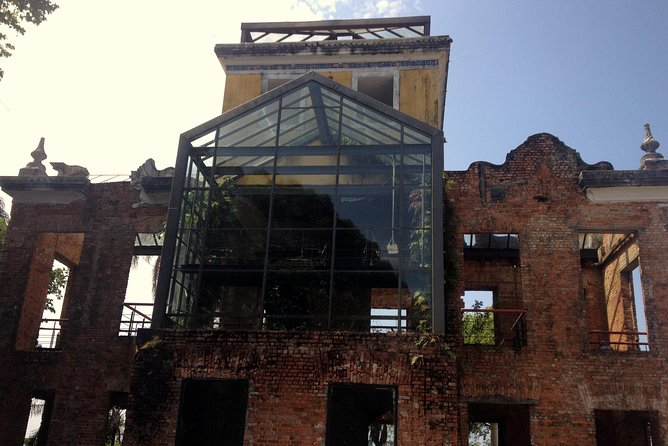
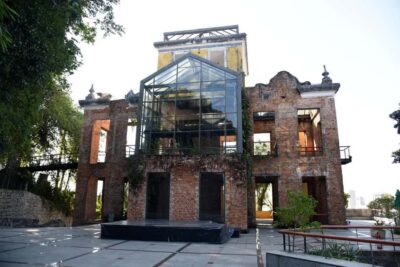
Next comes the Centro Cultural Municipal Parque das Ruínas, with about 30 minutes at the site. This is the former home of Laurinda Santos Lobo, later transformed into an open cultural center and viewing point.
The main reason to stop is the view. From the ruins, you can look across central Rio, toward the Lapa Arches, Christ the Redeemer, and Botafogo. Seeing those landmarks from one elevated place helps you read the city’s shape. The stop also gives the walk a pause after the tram and streets around Largo dos Guimarães.
Do not expect a formal museum visit with a long indoor program. The attraction is the old structure, the open setting, and the outlook across Rio. Depending on the day, you might find cultural activity at the center, but the tour information does not promise a specific exhibition or event.
For me, this is likely the strongest photo stop of the morning. The drawback is simple: views depend on weather and visibility. On a cloudy day, the city may not appear as sharply, though the building and setting still give the stop interest.
More santa teresa tours in Rio de Janeiro:
- Santa Teresa, Lapa, and Cinelândia with Tram Ride and Selarón Steps
★ 4.5 · 274 reviews - Rio de Janeiro: Historic Rio and Santa Teresa Half-Day Tour
★ 4.4 · 228 reviews - Ancient Rio and Santa Teresa Tour with Hotel pick-up and drop-off
★ 4.5 · 154 reviews - Centro Historico and Lapa – Santa Teresa Walking, Historical and Bohemian Tour
★ 5.0 · 44 reviews
Walking down to the Selarón Steps
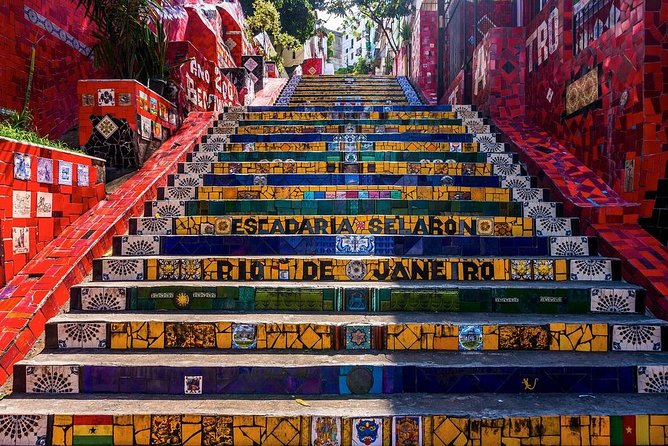
The route then leaves Santa Teresa for Lapa and reaches the Escadaria Selarón, or Selarón Steps. The stop lasts about 30 minutes.
The staircase was created over roughly 20 years by Chilean artist Jorge Selarón. Its colored tiles turn an ordinary hillside stairway into one of Rio’s most recognizable public artworks. The pattern, colors, and changes in tile make it a place to look closely, not just a backdrop for a quick photograph.
Your guide can give the steps a human story through Selarón himself and the long process of making the work. This is also a good point to ask about the role of public art in Rio, since the staircase is part artwork, part neighborhood passage, and part major city attraction.
The steps can be crowded, and the surface is not flat. Keep your footing and avoid assuming that you can move quickly through the entire area. Thirty minutes is enough for an explanation, photographs, and a look at the details, but not for a long, quiet inspection of every tile.
The Lapa Arches and street art
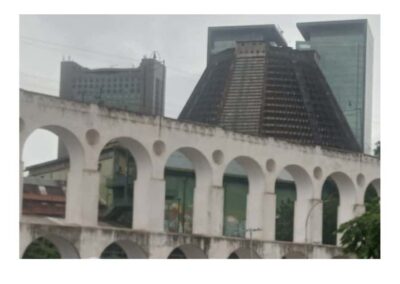
From Selarón Steps, you continue toward the Arcos da Lapa. The walk takes about 20 minutes at the arches, with additional time spent looking at graffiti and the streets along the way.
The arches are the remains of an 18th-century aqueduct that supplied water to Rio until the end of the 19th century. They later became part of the route used by the Santa Teresa tram. That connection gives the morning a satisfying return to its opening scene: you first cross the aqueduct by tram, then see it from below as a historic structure.
The walls around Lapa add a modern layer. Graffiti decorates many surfaces, and the route gives you a chance to see how old infrastructure and current street art share the same urban space. Lapa is not polished in the way some sightseeing districts are. Its rough edges are part of what you are seeing.
Stay close to the guide as you move through the area. The tour is designed for sightseeing, not independent wandering, and the guide’s local awareness helps you focus on the right streets and viewpoints. You also get a more useful visit when someone explains how the arches fit into Rio’s past and present.
Cinelândia and the grand center of Rio
The final sightseeing stop is Cinelândia, with about 20 minutes for an introduction to the square and its major buildings. This is a change of mood from Santa Teresa’s old villas and Lapa’s street art.
The square brings together the Teatro Municipal, Rio’s opera house; the Museu Nacional de Belas Artes; the Câmara Municipal; the Biblioteca Nacional; and the Teatro Odeon, the only cinema in the square still operating. Even a short orientation helps you understand why this area matters to Rio’s public and cultural life.
Twenty minutes is enough for an outside explanation and photographs, but not a full visit to any of these institutions. The tour does not include admission for an extended museum or theater visit. If you want to explore the interiors, plan that for another time.
Cinelândia also gives the tour a logical finish. You have moved from a hill neighborhood shaped by artists and old houses into the formal center, where grand civic buildings announce Rio’s role as a major capital and cultural city.
What the $72.09 price includes in practical terms
At $72.09 per person, this is not the cheapest way to see Santa Teresa and Lapa. You can walk through parts of both areas independently for less. The value comes from the route, the transport, and the guide’s interpretation.
The tram ticket is included. Past arrangements have also included metro travel, though you should confirm the exact transport plan for your date. A caipirinha has also been part of some tours, but it is not listed as a formal itinerary stop, so treat that as a possible extra rather than a guarantee.
The fee makes the most sense if you want to avoid piecing together the tram, Santa Teresa streets, the Selarón Steps, Lapa, and Cinelândia on your own. It also suits you if you want someone to explain the buildings and art rather than simply point them out.
The price is less compelling if you mainly want photographs and already feel comfortable using Rio’s public transport. In that case, the fixed route and guide may be more structure than you need. But for a first visit, the combination is efficient without being rushed.
The guides and the personal side of the tour
The strongest part of this experience is the guide. Edmundo, Lorena, and Ivan are specifically praised for friendly, personal tours. Their styles may differ, but the useful pattern is clear: you are likely to get more than a memorized list of dates.
Edmundo is an artist and has a strong connection to people in Santa Teresa. Lorena is praised for humor, candor, flexibility, and clear answers about Rio. Ivan is a Santa Teresa local who knows the neighborhood closely and can point out small details and local art.
That local contact can change the whole morning. Santa Teresa is best understood through its everyday life, not just its views. A guide who knows the neighborhood can help you notice the art shops, old homes, informal meeting places, and changes that are easy to miss when you walk alone.
When booking, you cannot be certain which guide will lead your date. If a particular guide matters to you, ask the provider before paying. The experience is provided by Good Guide In Rio, and the tour has a maximum of 12 people.
Who should book this walk
I would recommend it to a first-time Rio visitor who wants a compact introduction to several central districts. It is also a good fit if you enjoy public transport, city views, old architecture, street art, and guides who can add personal context.
You should be comfortable walking for most of a morning. The route includes hills, steps, and uneven streets. Most people can participate, but the tour is not designed around avoiding physical effort.
Art lovers will get plenty from the combination of Parque das Ruínas, Selarón’s staircase, local art in Santa Teresa, and graffiti in Lapa. You do not need a special interest in art, though. The route also works for anyone who wants to understand how Rio’s hill neighborhoods connect with the historic center.
It may not suit you if you want a long museum visit, extensive free time, or a slow café morning. Each stop has a clear time allotment, and the tour covers a lot of ground.
Timing, meeting point, and small details
The listed start time is 9:00 a.m. at the Copacabana Palace, A Belmond Hotel, on Avenida Atlântica. The activity is scheduled to end back at the meeting point, with a total duration of about 3 hours 30 minutes.
Some guide arrangements described in the tour experience have included meeting people at a hotel or bed-and-breakfast and using the metro before reaching the tram. Since the formal meeting point is the Copacabana Palace, confirm pickup details when booking rather than assuming door-to-door service.
Confirmation is provided at booking. The tour is near public transportation, and it requires a minimum number of participants. If that minimum is not reached and the activity is canceled, you are offered another date or experience, or a full refund.
The cancellation rule is strict: the booking is non-refundable and cannot be changed for any reason. Only book once your morning in Rio is firm.
Should you book it?
Book this tour if you want a guided introduction to Santa Teresa and Lapa with the tram ride, major viewpoints, street art, and city history arranged in one morning. The 100 percent recommendation rate and 5.0 rating from 59 reviews fit the experience’s main strengths: personable guides, a memorable route, and strong local knowledge.
I would especially choose it for a first Rio visit, or if you are uneasy about connecting public transport and hill neighborhoods on your own. Ask about the guide, the exact meeting arrangement, and whether the metro or a caipirinha is included on your date.
Skip it if you prefer complete independence or want to spend hours inside museums and historic buildings. For everyone else, $72.09 is a reasonable price for a small-group morning that shows you Rio through its tram tracks, tiled steps, old aqueduct, art-filled streets, and grand central square.
FAQ
Where does the tour start?
The listed meeting point is the Copacabana Palace, A Belmond Hotel, at Av. Atlântica, 1702, Copacabana, Rio de Janeiro.
What time does the tour begin?
The scheduled start time is 9:00 a.m.
How long does the tour last?
The experience lasts approximately 3 hours 30 minutes.
What transportation is used?
The route includes a ride on the famous yellow Santa Teresa tram. The tram admission ticket is included. Some tour arrangements have also used the metro, so confirm the transport plan for your date.
How many people can join?
The maximum group size is 12 people.
Does the tour return to the starting point?
Yes. The activity is listed as ending back at the meeting point.
Can I cancel for a refund?
No. The experience is non-refundable and cannot be changed for any reason. If the provider cancels because the minimum number of participants is not reached, you are offered another date or experience, or a full refund.
More Walking Tours in Rio de Janeiro
- Rio de Janeiro: Rocinha Favela Walking Tour with Local Guide
★ 4.8 · 3,052 reviews - Rio De Janeiro: Half-Day Rocinha Favela Walking Tour
★ 4.7 · 2,272 reviews - Sunrise and Sunrise Walk Two Brothers with Local Guide
★ 5.0 · 193 reviews - Rio de Janeiro: Little Africa Heritage Walking Tour
★ 4.9 · 177 reviews
Just added around Rio de Janeiro
- Vidigal Favela Tour★ 4.4 · 26 reviews
- Hang gliding flight in Rio de Janeiro★ 5.0 · 6 reviews
- Rio de Janeiro: Zip Lining and Canopy Tree Tour★ 3.3 · 6 reviews
- Rio de Janeiro: Attend a Vasco da Gama game with local guide★ 4.8 · 9 reviews
- Unforgettable Boat Party★ 5.0 · 3 reviews
- Tijuca Forest Hike – Waterfalls & Caves, Nature & Wild Life!★ 5.0 · 51 reviews
- Rio Highlights: Christ, Sugarloaf, and More in a Private Tour★ 5.0 · 36 reviews
- Tijuca Forest w/ Chinese View,cascatinha Taunay,horto waterfall and parque laje★ 4.5 · 29 reviews
Santa Teresa Tours, compared.

Santa Teresa, Lapa, and Cinelândia with Tram Ride and Selarón Steps
Read our review →

Ancient Rio and Santa Teresa Tour with Hotel pick-up and drop-off
Read our review →
Centro Historico and Lapa – Santa Teresa Walking, Historical and Bohemian Tour
Read our review →
Browse the lists this tour appears in