
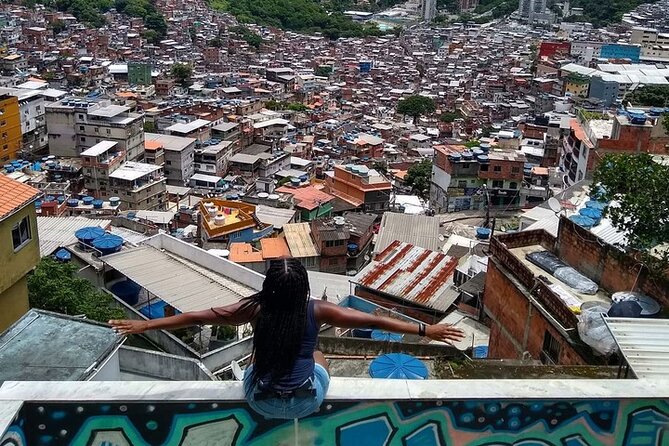
Reviewed · FAVELA TOURS
Rocinha Walking Tour: Get a Feel for the Brazil’s Largest Favela (Shared Group)
Rocinha is not a museum exhibit or a quick photo stop. It is a huge hillside community where you walk through narrow lanes, meet local artists, visit a resident’s home, and see how daily life unfolds above Rio. This small-group tour, led by a Rocinha resident, gives you a guided way into a part of the city you should not try to explore alone.
I like the maximum group of 10, which keeps the walk personal, and I like that your guide is a local rather than an outsider giving a distant explanation. The moto-taxi ride to the upper slopes is another smart touch: Rocinha is spread across steep ground, and the ride saves your legs while adding a short burst of excitement.
The main consideration is the physical effort. You will walk through alleys and uphill areas, then use a moto-taxi on narrow roads, so this suits people with moderate fitness more than anyone seeking an easy sightseeing loop.
In This Review
- Key points to know before you book
- Entering Rocinha from Copacabana
- Walking the alleys for about one hour
- The moto-taxi climb to Rocinha’s upper slopes
- Handicrafts, the market area, and local spending
- Laboriaux viewpoint above São Conrado
- Wark’s studio and the role of art
- Mrs. Maria’s home and a very personal view
- Safety, comfort, and the right mindset
- Is $100 a fair price for three hours?
- Who will get the most from this experience?
- Should you book the Rocinha Walking Tour?
- FAQ
- How long does the Rocinha Walking Tour last?
- Where does the tour begin?
- Where does the tour end?
- How many people can join the tour?
- Is transportation included?
- Is a guide included?
- Is food included?
- Can I cancel for a refund?
Key points to know before you book

- A resident guide gives the tour a local point of view, with the chance to meet family and friends in the community.
- The group is capped at 10 people, a useful limit for narrow lanes and personal questions.
- A moto-taxi carries you uphill, reaching viewpoints that would take more effort on foot.
- The Laboriaux viewpoint looks over São Conrado, beaches, and Tijuca Forest, giving you a striking view of Rio’s hills and coast.
- Local art is central to the visit, including a stop at graffiti artist Wark’s studio and the Wark Institute.
- The $100 price includes metro tickets and the moto-taxi, but not food, drinks, or tips.
Entering Rocinha from Copacabana
The outing begins at Praça Cardeal Arcoverde in Copacabana. Metro tickets are included, so you do not have to work out the local fare for the transport portion of the meeting arrangement.
From there, the focus shifts quickly from Rio’s familiar beach district to Rocinha’s steep lanes and dense streets. That change is part of the value. You are not simply looking down at a favela from a road or cable car. You are walking through it with someone who grew up there and still lives in the community.
Your guide is a licensed bilingual professional. Carlos is named as a guide connected with the experience, and his strong English was specifically praised. A local guide can explain what you are seeing in plain terms and help you understand the difference between a quick outsider’s impression and ordinary community life.
The group limit matters here. Rocinha is large, and its alleys are not designed for a 30-person procession. With no more than 10 people, you should have a better chance to hear the guide, ask questions, and move without blocking the way.
More favela tours in Rio de Janeiro:
- Rio de Janeiro: Rocinha Favela Walking Tour with Local Guide
★ 4.8 · 3,052 reviews - Rio De Janeiro: Half-Day Rocinha Favela Walking Tour
★ 4.7 · 2,272 reviews - Rio de Janeiro: Favela Santa Marta Top Tour with Local Guide
★ 4.9 · 488 reviews
Walking the alleys for about one hour
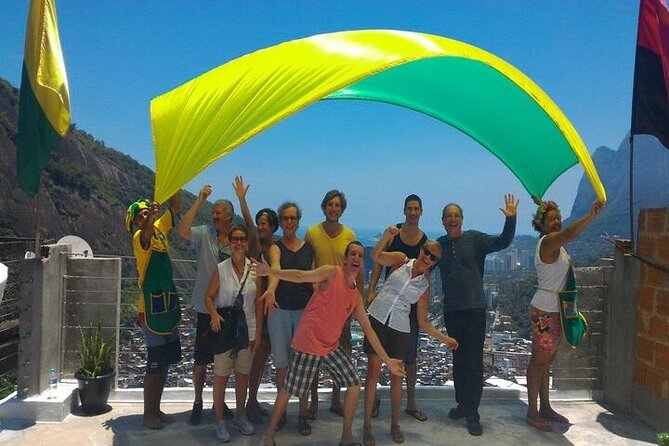
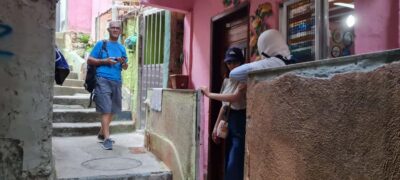
The first major part is on foot. You move through Rocinha’s alleys and see the physical setting up close, including the way homes and daily activity fit into a crowded hillside community.
This is the part of the tour that asks you to pay attention rather than rush from one landmark to another. The value comes from context: your guide explains how people live, introduces the community through personal connections, and helps you read the streets around you.
One especially personal detail is the chance to meet people connected to the guide. Carlos was described as introducing his sister and friends as the group passed through the area. That kind of contact can make the visit feel less staged, though you should still behave with care. Ask before taking photographs, listen when people speak, and remember that this is someone’s home rather than a performance space.
The route is not presented as a polished tourist district. Expect narrow passages, uneven walking, and a steady amount of uphill movement. The tour asks for moderate physical fitness, and that note should be taken seriously if you have trouble with slopes or longer walks.
The moto-taxi climb to Rocinha’s upper slopes
After the first walk, you take a moto-taxi uphill for about 20 minutes. The ride is included in the price and helps cover ground in a community spread across a steep hillside.
There is an adrenaline element here. Narrow lanes and sharp slopes make the ride feel more immediate than a regular taxi trip. At the same time, this will not appeal to everyone. If you dislike motorbikes or feel uneasy on tight uphill roads, consider that before booking.
The ride is not just a thrill added for its own sake. It gets you to higher parts of Rocinha without asking you to climb the entire route on foot. That makes the three-hour schedule workable and opens the way to the tour’s best views.
The route uses a local form of transport rather than keeping you inside a vehicle designed for tourists. You get a practical sense of how people move around the hillside, although the exact riding conditions can vary.
Handicrafts, the market area, and local spending
The next section takes about 40 minutes and focuses on community centers, handicrafts, and a shopping area that leads to a handcraft fair.
You may see jewelry, decorative objects, and souvenirs made or sold by local residents. This stop gives you a chance to buy something connected to the community rather than picking up the same mass-produced item found across Rio’s main shopping streets.
I also see a useful balance here. The tour does not treat Rocinha only as a place to observe poverty or urban problems. It includes work, art, small-scale commerce, and the skills of people earning money within their own neighborhood.
Food and drinks are not included, and the tour information does not promise a meal stop. Bring your budget for any handicrafts you want to buy, but do not assume that purchases are part of the $100 price.
A few more Rio de Janeiro trips to weigh up
- Sunrise and Sunrise Walk Two Brothers with Local Guide
★ 5.0 · 193 reviews - Rio de Janeiro: Little Africa Heritage Walking Tour
★ 4.9 · 177 reviews - Learn the History of Rio with an Unforgettable City Center Walking Tour
★ 5.0 · 82 reviews - Rio’s city walking tour: a glimpse of history and olympic legacy
★ 4.5 · 78 reviews
Laboriaux viewpoint above São Conrado
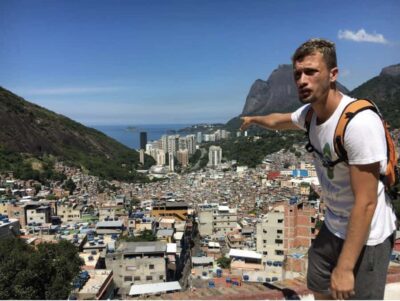
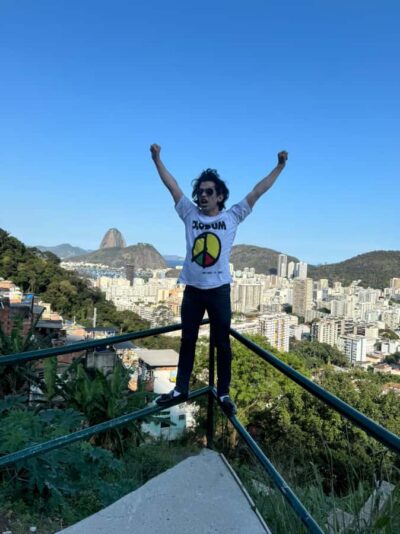
Morro do Laboriaux is described as the highest point in the favela. You spend about 30 minutes there, taking in views toward São Conrado beach, Rio’s other beaches, and the slopes of Tijuca Forest.
This is the visual payoff of the uphill route. From high above, Rocinha’s density meets Rio’s famous combination of coast, forest, and steep hills. The view helps you understand the community’s setting in a way that a street-level walk cannot.
You will want time for photographs, but the best reason to pause is scale. Looking across the slopes and toward the water gives you a clearer sense of how closely the city’s wealthy districts, forested hills, beaches, and favela communities sit together.
The viewpoint is not a substitute for the walking portion. It shows the wider setting, while the alleys and homes show daily life at close range. The tour works best because it offers both perspectives in one morning or afternoon.
Wark’s studio and the role of art
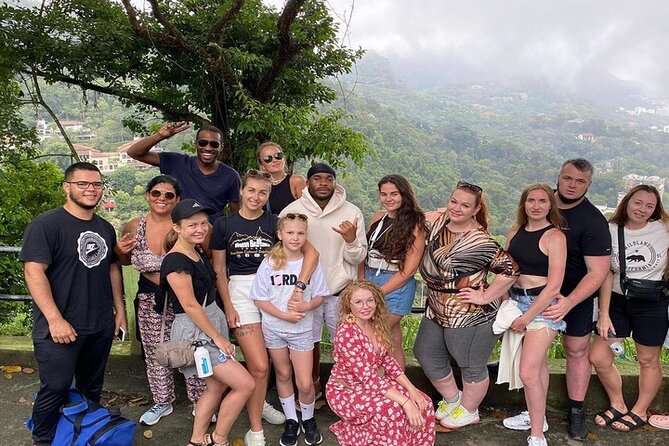
The visit to graffiti artist Wark’s studio lasts about 20 minutes. Wark grew up in Rocinha and was an early figure in the favela’s graffiti movement. His work drew attention from prominent Brazilian leaders, including former president Luiz Inácio Lula da Silva.
You can see where an artist from the community creates and sells work, rather than treating street art as background decoration. Wark’s works have earned hundreds of reais, showing how graffiti can be both creative expression and a source of income.
The stop also connects art with youth education. Wark founded the Wark Institute, a school where young people in Rocinha can learn and practice art. That gives the studio visit a wider purpose, especially if you are interested in how local projects create opportunities for young people.
Twenty minutes is enough for an introduction, not an art seminar. If Wark is present, you may have a more direct encounter with the artist and his work, but the supplied details do not guarantee a particular length of conversation or a specific exhibition.
Mrs. Maria’s home and a very personal view
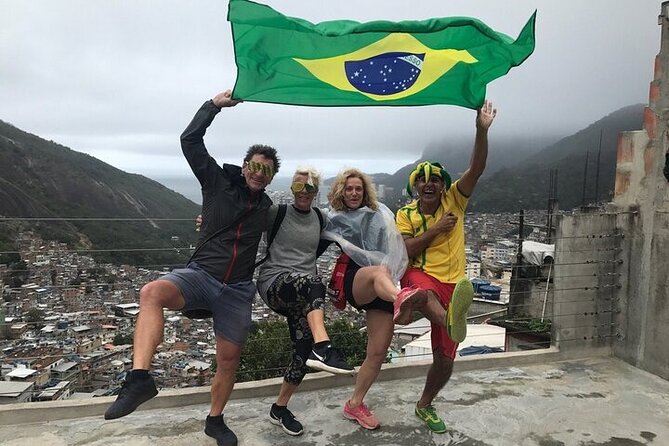
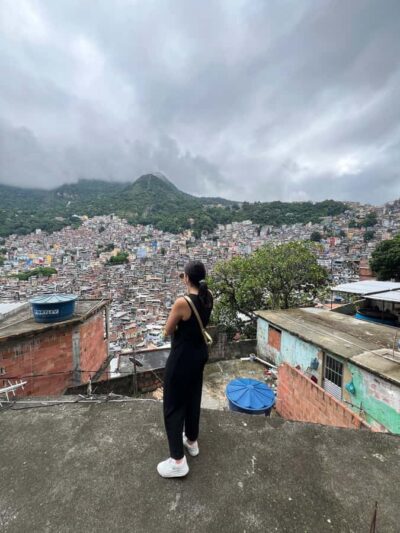
The final listed stop is a 10-minute visit to the home of Mrs. Maria, who has lived in Rocinha for 32 years. From the slab of her house, you get a view toward São Conrado beach and across the favela.
This may be the most intimate part of the experience. You are not only seeing the neighborhood from a public lookout. You are entering the home of someone who has spent decades living there and seeing the community change around her.
A home visit needs respectful conduct. Keep the group’s presence brief, follow the guide’s instructions, and ask before photographing people or private spaces. The short time is appropriate because the stop should feel like a welcome into someone’s home, not an extended inspection.
The setting also makes the tour’s message clear: Rocinha is a place of families, artists, workers, and long-term residents. The view from Mrs. Maria’s home combines the human scale of the visit with the wide Rio panorama.
Safety, comfort, and the right mindset
The strongest practical point is to go with the local guide and the group. A person who knows Rocinha can manage the route, explain local customs, and decide how to move through the community. The group size of 10 or fewer also helps.
A past participant described feeling safe while visiting with a 73-year-old mother, even though both women felt far outside their usual surroundings. That experience suggests the tour can work for older people who are reasonably fit, but it does not remove the need for care on slopes, steps, or the moto-taxi ride.
Wear comfortable shoes and expect walking. The operator specifically lists moderate fitness as a requirement. The exact details of the alleys are not promised, so avoid assuming that every surface will be smooth or easy.
You should also arrive ready to observe rather than judge. Rocinha is a lived-in community, and the most worthwhile moments may be simple ones: a conversation with the guide, an introduction to a relative, a look at local craftwork, or a view from a resident’s home.
Is $100 a fair price for three hours?
At $100 per person, this is not Rio’s cheapest sightseeing activity. The price makes more sense when you count what is included: metro tickets, a licensed bilingual guide, taxes, and the moto-taxi ride to the top of Rocinha.
You are also paying for access and organization. Walking through a large favela without local help would not offer the same context or peace of mind, and attempting to arrange the route independently could mean missing the viewpoints, studio, market area, and home visit.
The tour is a good value if you want a focused, personal introduction to Rocinha and prefer to support a local guide and community-based stops. It is less attractive if you only want a panoramic view or a quick photo. For that, a shorter lookout visit would be simpler.
Food and drinks cost extra, as do tips. Tipping is optional, but you may want to budget for it if the guide provides the personal, careful service this type of visit requires.
Who will get the most from this experience?
I would recommend this tour to you if you want to understand Rio beyond its beaches and postcard views. It suits people who are curious about daily life, local art, community businesses, and the personal stories behind a place often reduced to a label.
It is also a good fit for a small family group or friends who want a guided outing with a strong human element. The example of a 73-year-old participant shows that age alone is not a barrier, provided you can manage moderate walking and feel comfortable with the moto-taxi.
You may want to skip it if you need a fully smooth, passive sightseeing experience. The route includes walking in narrow alleys, uphill access, and a motorbike ride. You should also think carefully about photography and privacy, since the visit takes place in a working residential community.
The experience is rated five out of five from 37 reviews, with 100 percent recommending it. Those numbers point to consistent satisfaction, but the real deciding factor is your interest in a respectful, close-up community visit rather than a standard city tour.
Should you book the Rocinha Walking Tour?
Book it if you want a local-led view of Rio, have moderate fitness, and can approach Rocinha with respect and curiosity. The combination of a resident guide, a small group, hilltop views, community handicrafts, Wark’s art, and Mrs. Maria’s home gives the three hours a clear purpose.
The tour is especially useful early in your Rio stay, when you want to understand how the city’s hills, beaches, forests, and neighborhoods fit together. It is not the right choice for a relaxed stroll or a trip built around food and shopping, since neither meals nor drinks are included.
You can cancel for a full refund up to 24 hours before the start time. If you are still unsure, use the physical fitness requirement and the moto-taxi ride as your test: if both sound manageable, this is one of the more personal ways to see a side of Rio that most standard tours leave out.
FAQ
How long does the Rocinha Walking Tour last?
The tour lasts approximately three hours.
Where does the tour begin?
It begins at Praça Cardeal Arcoverde on Rua Barata Ribeiro in Copacabana, Rio de Janeiro.
Where does the tour end?
The activity ends back at the meeting point in Copacabana.
How many people can join the tour?
The group has a maximum of 10 people.
Is transportation included?
Yes. Metro tickets and a moto-taxi ride to the top of Rocinha hill are included.
Is a guide included?
Yes. The tour includes a licensed bilingual private tour guide. The experience is led by a Rocinha resident.
Is food included?
No. Food and drinks are not included. Tips are optional.
Can I cancel for a refund?
Yes. You can cancel at least 24 hours before the start time for a full refund. Cancellations or changes made less than 24 hours before the start time are not accepted for a refund.
Just added around Rio de Janeiro
- Vidigal Favela Tour★ 4.4 · 26 reviews
- Hang gliding flight in Rio de Janeiro★ 5.0 · 6 reviews
- Rio de Janeiro: Zip Lining and Canopy Tree Tour★ 3.3 · 6 reviews
- Rio de Janeiro: Attend a Vasco da Gama game with local guide★ 4.8 · 9 reviews
- Unforgettable Boat Party★ 5.0 · 3 reviews
- Tijuca Forest Hike – Waterfalls & Caves, Nature & Wild Life!★ 5.0 · 51 reviews
- Rio Highlights: Christ, Sugarloaf, and More in a Private Tour★ 5.0 · 36 reviews
- Tijuca Forest w/ Chinese View,cascatinha Taunay,horto waterfall and parque laje★ 4.5 · 29 reviews
Favela Tours, compared.

Favela Rocinha Tour with Local Guide & Secret Spots
Read our review →

Favela Tour The Original, Rocinha & Vila Canoas since 1992
Read our review →
Browse the lists this tour appears in