
Reviewed · MUSEUMS
Official Ticket: Oceanographic Museum Univali – Piçarras – SC
The most striking part of the Univali Oceanographic Museum is its range. In one visit, you move from fossils and ancient sea creatures to shark jaws, sea turtles, penguins, whales, and live aquariums. The collection covers more than 1,400 pieces, so this is not a quick room with a few shells in glass cases.
I especially like the seven color-coded wings, which give the visit a clear route, and the sensory experience with marine animals, which adds something hands-on for children and adults. The full-scale outdoor panel showing a 33-meter blue whale is another memorable touch.
The main drawback is presentation. Some displays have limited explanations, and several areas may feel too dark. The aquariums also have less live activity than you might expect, so the museum works best for people who enjoy specimens, science, and context, not only large tanks full of fish.
In This Review
- Key points before you go
- Starting with fossils, voyages, and ocean exploration
- Red wing: shells, corals, squid, and crustaceans
- Green wing: sharks, rays, and the great white jaw
- Brown wing: the range of bony fish
- Gray wing: Brazil’s five sea turtle species
- Beige wing: penguins and the wandering albatross
- Black wing: whaling, dolphins, and manatees
- The Ocean Giants panel outside
- The sensory experience and the museum’s limits
- Is $15.68 good value for 60 to 90 minutes?
- Who will enjoy this museum most?
- Planning your visit in Piçarras
- Should you book the Univali Oceanographic Museum?
- FAQ
- Where is the Univali Oceanographic Museum?
- How much does admission cost?
- How long does a visit take?
- What are the museum’s opening hours?
- Is the museum open on Mondays?
- What is included with admission?
- Is an educational package included?
- Does the museum have live animals?
- Which sea turtles are shown?
- Can I cancel for a refund?
Key points before you go
- More than 1,400 pieces: The museum covers a broad sweep of Brazilian marine biodiversity, with preserved specimens, skeletons, shells, fossils, and live animals.
- Seven themed wings: Color-coded sections cover oceanography, invertebrates, cartilaginous fish, bony fish, reptiles, seabirds, and marine mammals.
- A rare great white shark jaw: The green wing includes the only white shark jaw displayed in Brazil.
- A strong sea turtle display: All five sea turtle species found in Brazil are represented, from hatchlings to giant adults.
- Hands-on marine contact: The sensory experience gives you a chance to interact with marine materials and animals in a supervised setting.
- Allow 60 to 90 minutes: The museum is compact enough for a short visit, but the collection rewards a slower look.
Starting with fossils, voyages, and ocean exploration
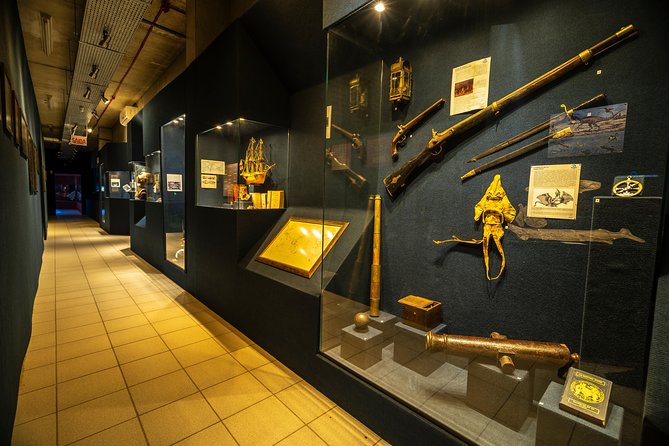
Your visit begins in the blue wing, where the museum sets up the story of life in the sea. Fossils from different geological ages show how marine life changed over time. This gives the rest of the collection a useful frame: you are not just looking at isolated shells and fish, but at a long record of life and adaptation.
The displays also connect the sea to human curiosity. Historical objects and information about ancient civilizations show how people have tried to understand and use the ocean. The section then moves toward famous voyages, major figures in oceanography, and modern tools used to explore the sea.
I find this opening helpful because it gives children a simple question to carry through the museum: how did life get from those early forms to the animals in the aquariums? Adults may appreciate the shift from old exploration methods to current technology.
The main weakness is that not every object has the same level of explanation. If you want detailed information about every specimen, you may need to spend extra time reading the available labels and filling in some gaps yourself.
A few more Brazil trips to weigh up
- Petrópolis Day Trip from Rio de Janeiro including Imperial Museum and Crystal Palace
★ 4.0 · 101 reviews - 7-Hour Shared Group Santos Tour : Mont Serrat, Coffee Museum and Sightseeing
★ 5.0 · 68 reviews - Olympic Boulevard, Museum of Tomorrow & Historical Rio
★ 4.5 · 66 reviews
Red wing: shells, corals, squid, and crustaceans
The red wing focuses on marine invertebrates, a group that is easy to overlook beside sharks and whales. Here, the museum pairs preserved examples with aquariums containing live animals of related types. That comparison helps you see how a hard skeleton, shell, or body shape functions in a living creature.
You will find calcareous structures from sponges and corals, a wide range of mollusk shells, and preserved examples such as a whole giant squid. The shapes are the real lesson. A shell is not merely decorative, and the collection gives you a chance to compare the many ways mollusks protect themselves and move through the sea.
Echinoderms appear through sea stars, sea urchins, and sea cucumbers. The wing ends with crustaceans, including shrimp, crabs, lobsters, and related species. The variety makes this one of the better sections for families, especially if you want to show children that marine life is far more than fish.
Some pieces are easier to appreciate than others because the labels do not always provide enough detail. I would read the section slowly instead of rushing to the next wing, since the smaller animals reward close attention.
Green wing: sharks, rays, and the great white jaw
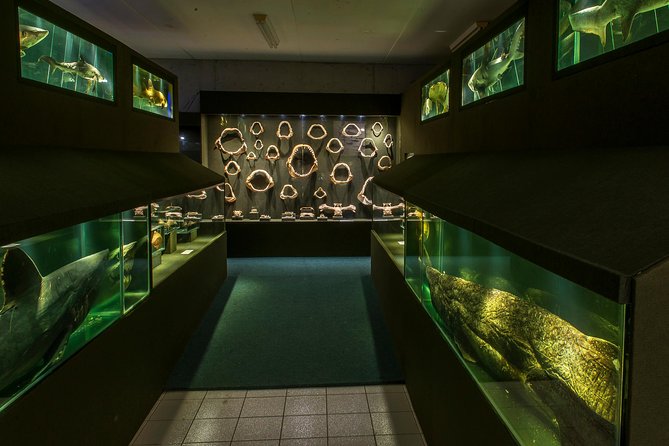
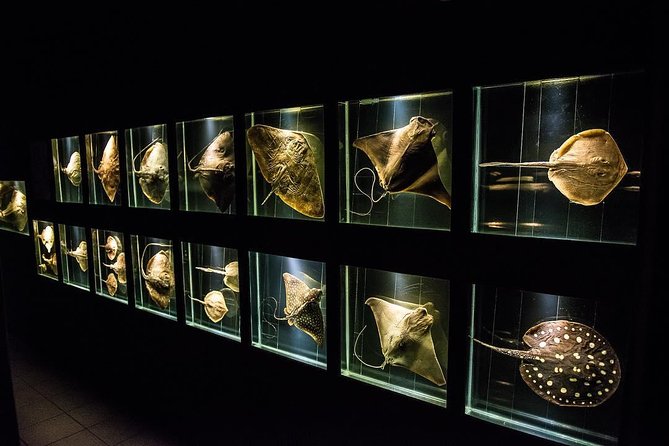
The green wing is likely to be a favorite for anyone who came mainly to see sharks and rays. The collection includes coastal, deep-sea, and endangered species, along with teeth and jaws that show how these animals feed.
The strongest object here is the great white shark jaw, described as the only one of its kind on display in Brazil. Even without a live great white in a tank, the jaw gives you a practical sense of the animal’s scale and feeding equipment. It is the sort of display that makes abstract information about sharks feel physical and immediate.
The wing also explains reproduction. Sharks and rays use several reproductive strategies, and those differences help explain how they survive in habitats ranging from shallow coastal water to the deep sea.
Four aquariums represent the natural habitats of these animals. They add motion and help balance the preserved specimens, though you should keep your expectations measured. This is a museum collection with live aquariums, not a large public aquarium built around enormous tanks.
Brown wing: the range of bony fish
The brown wing presents the main families of bony fish and focuses on the many shapes and adaptations found in this group. It includes large species such as tarpon and oceanic swordfish, giving you a look at fish that do not fit the small, colorful image many people have of aquarium life.
The collection also includes aquariums with fish from the Indian and Pacific oceans. That wider geographic range makes the section useful for comparing marine environments beyond southern Brazil.
A particularly unusual display focuses on deep-sea fish from the abyssal zone, more than 2,000 meters below the surface. These animals are difficult to encounter in ordinary settings, so preserved specimens can be valuable here. They show how life changes when there is extreme pressure, very little light, and a very different food supply.
This wing is more about form and adaptation than spectacle. If you enjoy identifying species and comparing body shapes, you may spend longer here. If you want constant movement, the preserved displays may feel quieter.
Same city, a completely different kind of day:
- Rio de Janeiro: 6-Stop Highlights of Rio with Lunch
★ 4.4 · 5,157 reviews - Christ the Redeemer Entry Ticket by Corcovado Train
★ 4.4 · 4,476 reviews - Rio de Janeiro: Rocinha Favela Walking Tour with Local Guide
★ 4.8 · 3,052 reviews - Rio de Janeiro: Sugarloaf Cable Car Official Ticket
★ 4.6 · 2,873 reviews
Gray wing: Brazil’s five sea turtle species
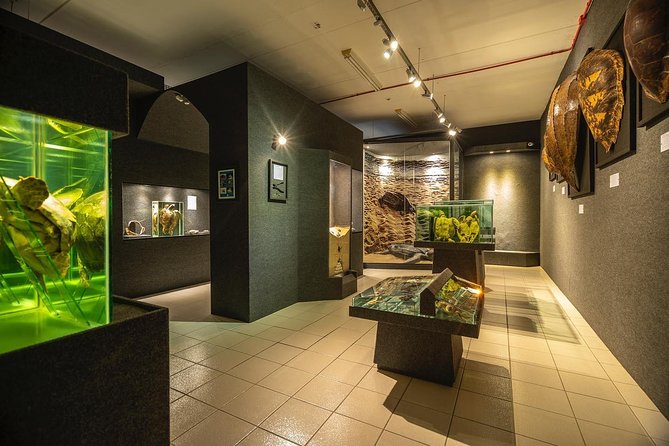
The gray wing is devoted to marine reptiles, with sea turtles taking center stage. Brazil has five sea turtle species, and the museum presents all five. That makes this one of the clearest sections for understanding the range of turtles found along Brazil’s coast.
The displays cover different stages of life, from small hatchlings to giant adults. Size alone makes the progression useful. A young turtle can look almost fragile, while the adult specimens show how large and powerful these animals become.
The exhibition also addresses biology and ecology, so you get more than a basic species display. You can consider how the turtles are built for marine life and how their needs change as they grow.
The turtle section is a good reason to bring children, but it is not only for families. I like it as a reminder that conservation starts with knowing the animals themselves. The museum’s broader collection gives this wing added context, placing turtles alongside the other marine species that share their environment.
Beige wing: penguins and the wandering albatross
The beige wing turns to seabirds. All penguin species are presented, with attention to their distribution in the Southern Hemisphere. This is useful because penguins are often treated as a single familiar group, even though different species live in different parts of the hemisphere and have different adaptations.
The centerpiece is a diorama of an oceanic island. It includes endangered wandering albatrosses, one of the largest seabirds in the world. The display helps you think about how seabirds depend on isolated islands and open water, rather than simply presenting them as mounted specimens.
This section may take less time than the shark or turtle areas, but it gives the museum a broader reach. The ocean is also a bird habitat, and the exhibit makes that point without needing a huge amount of space.
Lighting is one issue to keep in mind throughout the museum, and it can affect the smaller seabird displays. Take your time and look closely at the labels and silhouettes rather than relying on a quick glance.
Black wing: whaling, dolphins, and manatees
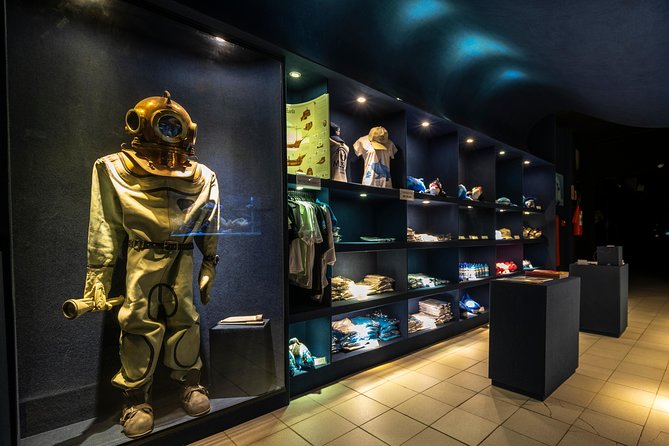
The black wing opens with the history of whaling and its commercial use in Santa Catarina. That local connection matters. It places marine exploitation in the region where you are visiting, rather than treating whaling as a distant subject with no connection to Brazil.
The exhibition then presents dolphins and whales found in southern Brazil, with information about their biology. You also see South American fur seals, sea lions, and manatees from northeastern Brazil.
This section has a more serious tone than the earlier displays. The museum is not only showing beautiful animals. It is also asking you to consider how human industries affected marine mammals and why knowledge of their biology matters.
For me, this is one of the more useful parts of the visit because it links natural history with human behavior. The collection is strongest when it does this kind of connecting work. Again, some photographs and specimens would benefit from fuller labels, so you may not get every detail you want from the display itself.
The Ocean Giants panel outside
Before leaving, make time for the Ocean Giants panel outside the museum. It shows the largest marine animals from each major group at full scale.
The blue whale is the main attraction. The panel represents an animal about 33 meters long and weighing 170 tons, making it the largest animal known to have lived on Earth. Numbers can be hard to picture, but a full-scale comparison gives you a better feel for that size.
This outdoor section also works well as a break after the indoor exhibits. You can step back, look at the proportions, and compare the whale with the other marine giants. It is especially effective for families because size is easy to understand even when the scientific details are not.
The sensory experience and the museum’s limits
The included sensory experience with marine animals gives this visit a useful change of pace. Instead of only looking at preserved specimens, you have an opportunity for direct contact with the marine world through the touch activity.
This is the part I would prioritize if you are visiting with children. It can also appeal to adults who prefer an active museum experience. The hands-on element helps turn a lesson about marine biology into something physical and memorable.
Still, keep your expectations realistic. The sensory activity is one part of the museum, not a long separate workshop. An educational package is available for groups, but it is not included in the standard admission described here.
The museum’s darker lighting is another consideration. Low light may help protect or present certain objects, but it can make labels and photographs harder to read. Some sections also have fewer live fish than you might hope for, and the aquariums are there to support the collection rather than replace it.
Is $15.68 good value for 60 to 90 minutes?
At $15.68 per person, the value depends on how you like to spend museum time. I consider it fair if you enjoy natural history, preserved specimens, and well-organized subject sections. You are paying for access to a large collection, live aquariums, the sensory activity, and the outdoor whale panel.
The price feels less attractive if you want a major aquarium experience with large tanks and constant animal activity. Several displays are specimen-based, and parts of the collection have limited written explanation. In that case, the visit may feel short or less satisfying for the cost.
The expected visit length is about one hour to one hour and 30 minutes. That makes the museum easy to fit into an afternoon in Piçarras, but the opening hours are narrow: Tuesday through Sunday, from 2:00 PM to 5:30 PM. There is no Monday opening listed, and the fixed afternoon window matters if you are planning several activities on the same day.
I would allow the full 90 minutes if you want to read the displays and compare the species. If you are mainly interested in the headline pieces, you can see the core areas in about an hour.
Who will enjoy this museum most?
I would recommend it most strongly to:
- Families with children who like animals and will enjoy the sensory activity
- Anyone interested in sharks, rays, sea turtles, whales, or marine conservation
- Museum visitors who prefer specimens and scientific displays to entertainment rides
- People looking for a compact afternoon activity in Piçarras
- Students and marine-life enthusiasts who want a broad introduction to Brazilian ocean biodiversity
You may want to skip it if you dislike preserved animals, need extensive labels for every piece, or expect a large aquarium with many active tanks. The collection has scale and variety, but the presentation can feel dark and quiet.
Most travelers can participate, and service animals are allowed. No special physical demands are described, so the visit should suit a broad range of visitors, though the available information does not provide detailed access notes for every area.
Planning your visit in Piçarras
Because the museum opens only in the afternoon, check your schedule before booking. A 2:00 PM arrival gives you the most time and leaves room to move through the wings without rushing.
You should also plan around the museum’s strongest displays. Start with the blue wing to understand the basic story, then pay special attention to the green, gray, and black wings if sharks, turtles, and marine mammals interest you most. Finish outdoors at the Ocean Giants panel.
The museum has free cancellation when you cancel at least 24 hours before the experience start time. Inside 24 hours, the payment is not refunded, and changes are not accepted. The local time cutoff applies.
Should you book the Univali Oceanographic Museum?
Book it if you want a thoughtful, reasonably short look at Brazilian marine life, especially if sharks, sea turtles, fossils, or marine mammals interest you. The great white shark jaw, the complete display of Brazil’s five sea turtle species, the deep-sea fish, and the full-scale blue whale give the museum plenty of distinctive material.
I would be more cautious if your main goal is a large aquarium show. The displays can be dim, labels are incomplete in places, and some tanks may feel lightly stocked. But at roughly 60 to 90 minutes, the museum offers a solid afternoon activity and a useful lesson in how much life exists beyond the familiar postcard animals.
FAQ
Where is the Univali Oceanographic Museum?
The museum is in Piçarras, in the state of Santa Catarina, in southern Brazil.
How much does admission cost?
The listed price is $15.68 per person.
How long does a visit take?
Plan for approximately one hour to one hour and 30 minutes.
What are the museum’s opening hours?
The museum is open Tuesday through Sunday from 2:00 PM to 5:30 PM.
Is the museum open on Mondays?
No Monday opening is listed in the provided schedule.
What is included with admission?
Admission includes access to the exhibition and the sensory experience with marine animals.
Is an educational package included?
No. An educational package is available for groups but is not included with the standard admission.
Does the museum have live animals?
Yes. Live animals are presented in aquariums, alongside preserved specimens, fossils, shells, skeletons, and other pieces.
Which sea turtles are shown?
The museum presents all five sea turtle species found in Brazil, including examples ranging from small young turtles to giant adults.
Can I cancel for a refund?
Yes, you can receive a full refund if you cancel at least 24 hours before the experience start time. Cancellations within 24 hours are not refunded, and changes made within that period are not accepted.
Just added around Brazil
- Vidigal Favela Tour★ 4.4 · 26 reviews
- Hang gliding flight in Rio de Janeiro★ 5.0 · 6 reviews
- Walking Tour of São Luís do Maranhão★ 4.4 · 14 reviews
- Paraty Historical City Walking Tour★ 4.1 · 8 reviews
- Rio de Janeiro: Zip Lining and Canopy Tree Tour★ 3.3 · 6 reviews
- Rio de Janeiro: Attend a Vasco da Gama game with local guide★ 4.8 · 9 reviews
- Unforgettable Boat Party★ 5.0 · 3 reviews
- Trindade Day Trip: Nature and Sea Adventure from Paraty★ 4.6 · 5 reviews
Museums, compared.

Petrópolis Day Trip from Rio de Janeiro including Imperial Museum and Crystal Palace
Read our review →
7-Hour Shared Group Santos Tour : Mont Serrat, Coffee Museum and Sightseeing
Read our review →
Olympic Boulevard, Museum of Tomorrow & Historical Rio
Read our review →
Olympic Boulevard, AquaRio and Museum of Tomorrow Tour
Read our review →
Olympic Boulevard, Museum of Tomorrow & History Tour
Read our review →
Petrópolis Trip with Palace, Imperial Museum & Brewery
Read our review →
Museum of Tomorrow Guided Tour, Admission & Transfer
Read our review →
MUSA and INPA Museums with Observation Tower Tour
Read our review →Browse the lists this tour appears in