
Reviewed · MUSEUMS
Museum of Tomorrow Guided Tour, Admission & Transfer
Rio’s Museum of Tomorrow is less a traditional museum than a guided conversation about where human choices may lead. Its spaceship-like Santiago Calatrava building sets the tone, while interactive displays connect science, art, technology, culture, oceans, politics, and the future of the planet.
I like the guided interpretation, especially because the exhibits can be dense and some material is in Portuguese. I also like that the trip adds Mauá Square and Olympic Boulevard, giving you bay views, public art, and a look at Rio’s changing port district. The main caution is timing: late pickup or a fast guide can reduce your museum time, and English ability may vary.
In This Review
- Key points to know
- Why the Museum of Tomorrow is worth your afternoon
- The Calatrava building sets the mood
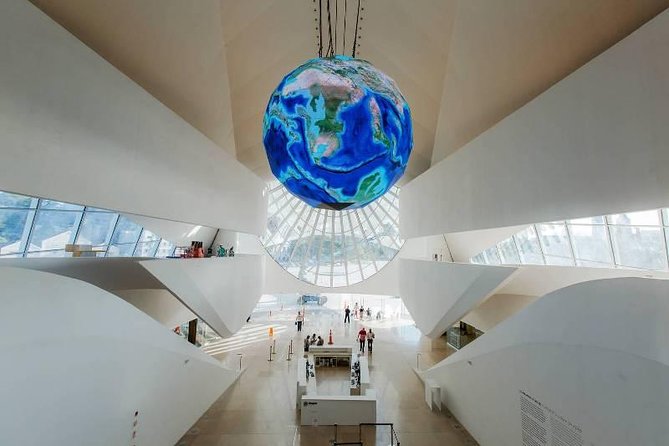
- Inside the museum: ideas rather than old objects
- Allow enough time for the main attraction
- Mauá Square and the Guanabara Bay view
- Olympic Boulevard and Kobra’s giant mural
- Porto Maravilha gives you a different Rio
- Is $58 a fair price?
- Guides can make or break the experience
- Who should book this tour?
- The practical booking decision
- FAQ
- How long does the Museum of Tomorrow tour last?
- What is included in the price?
- Are food and drinks included?
- Where does pickup take place?
- Does the tour return to the starting point?
- Is there an extra charge for pickup in Barra or Recreio?
- How large is the tour group?
- Is the tour available in languages besides English?
- Can I cancel for a full refund?
Key points to know
- The Museum of Tomorrow gets most of the time: Plan on roughly three hours at the main attraction, though some tours may move faster.
- The building is part of the experience: Santiago Calatrava’s dramatic structure makes a strong first impression before you even enter.
- A guide helps with the exhibits: Guides such as Jaqueline, Renato, Marcos, and Christian have been praised for clear explanations and personal attention.
- The outdoor stops add Rio context: Mauá Square offers Guanabara Bay views, while Olympic Boulevard features Kobra’s enormous Mural das Etnias.
- Transport is useful from Copacabana: Pickup begins at Hotel Rio Othon Palace, and the air-conditioned vehicle returns you there.
- The price is about convenience as much as admission: At $58 per person, you are paying for entry, transport, guiding, and a compact introduction to Porto Maravilha.
Why the Museum of Tomorrow is worth your afternoon
Rio has no shortage of grand churches, colonial streets, beaches, and lookout points. This museum gives you something different: a chance to think about the future while standing in one of the city’s most modern districts.
The central idea is simple but effective. The museum asks how human decisions affect the planet, then uses screens, interactive stations, videos, objects, and data to make those questions easier to grasp. The themes include human existence, environmental pressure, political choices, technology, oceans, and possible futures.
That approach works best if you enjoy museums that ask questions rather than simply display old objects. You are not walking through a collection of paintings or historic rooms. Instead, you move through a sequence of ideas about how people use resources and what may happen next.
I especially like the way the experience links subjects that are often kept apart. Science is not treated as a dry school lesson, and environmental concerns are not presented only as slogans. Art and technology help give the information shape, while culture and human behavior keep the subject tied to everyday life.
The experience can also be useful for families, older children, and adults who normally lose interest in museums. The interactive format gives you something to do, not just something to read. Still, the museum may feel more conceptual than some visitors expect. If you prefer historic artifacts and detailed local history, this will not feel like a conventional museum visit.
A few more Rio de Janeiro trips to weigh up
- Private Transfer GIG International Airport To or From Rio de Janeiro
★ 4.5 · 109 reviews - Exclusive Private Rio Tour: Guide & Private Car/Driver
★ 5.0 · 83 reviews - Private Bilingual Transfer – City of Rio de Janeiro
★ 5.0 · 74 reviews
The Calatrava building sets the mood
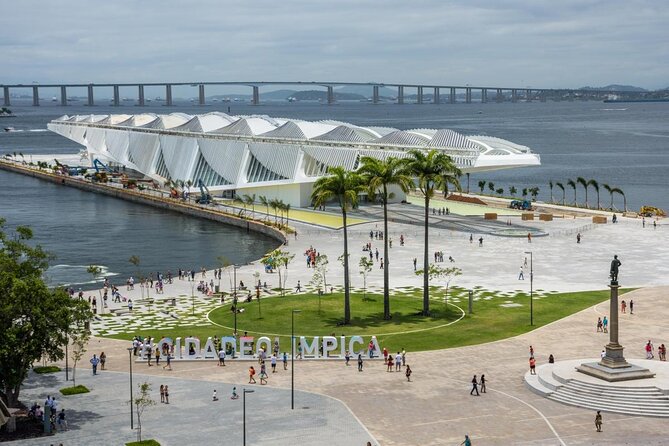
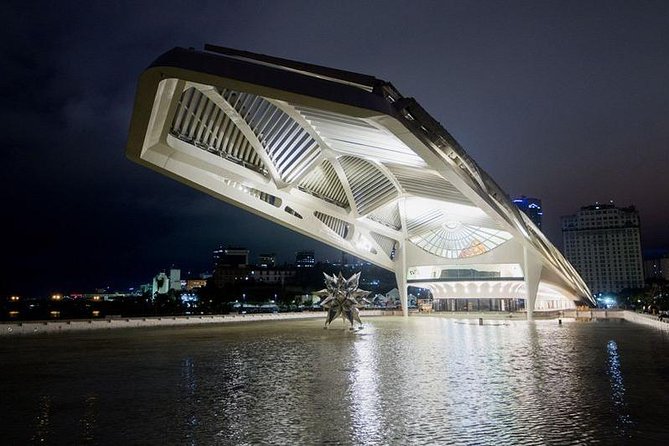
Before considering the exhibits, take time to look at the building. Designed by Santiago Calatrava, it has a long, white, futuristic form that reaches out toward Guanabara Bay. Its shape has helped make the museum one of the defining sights of Porto Maravilha.
The architecture is not a minor detail here. It prepares you for the museum’s central concern: a city and planet looking ahead. The structure feels more like a spacecraft or a machine for thought than a standard cultural building.
You will also find useful photo opportunities around the exterior. The bay, the waterfront, and the cruise ship terminal next door create a very different view of Rio from the familiar scenes around Copacabana and Ipanema.
The building’s design also helps manage the flow of people. One visitor specifically noted that the layout seemed made to guide crowds through the displays. That matters in a museum built around screens and interactive stations, where congestion could otherwise make the visit frustrating.
Do not rush past the outside area. The museum interior gets the attention, but the exterior gives you a better sense of the building’s relationship with the water and with the wider port renewal project.
Inside the museum: ideas rather than old objects
The museum’s displays focus on the conditions that shape life on Earth and the choices that may influence the future. You might encounter information presented through moving images, interactive activities, visual comparisons, and quantified data.
One of the most useful features is the effort to compare current conditions with possible future outcomes. Environmental, oceanic, and political risks are shown in ways that can make abstract issues easier to understand. The point is not simply that the future is uncertain. It is that human action has a measurable role in shaping it.
The exhibits also encourage you to make connections. A decision about energy, food, urban growth, or technology can affect oceans, climate, public health, and politics at the same time. The museum’s strength is showing those links in one place.
Some displays may require patience, particularly if you are reading in a language you do not speak. This is where a guide can make a real difference. Guides have explained Portuguese text, connected the displays to wider issues, and adjusted their pace for individual needs.
Marcos was singled out for helping a visitor with mobility issues, and Christian was praised for guiding someone through the full experience and taking photos. Jaqueline was described as doing more than driving, with explanations tailored to personal interests. Renato also received praise for combining tour information with local history.
Those details point to the most important variable in this tour: the guide. A good guide can turn a series of polished screens into a coherent story. A rushed or less confident guide may leave you mainly looking at displays on your own.
Allow enough time for the main attraction
The schedule assigns about three hours to the Museum of Tomorrow, with roughly 30 minutes at Mauá Square and another 30 minutes at Olympic Boulevard. In practice, the museum is the part that deserves protection if time becomes tight.
Several comments suggest that some visits lasted about two hours, while another recommendation allowed at least an hour and a half. The official duration is approximately four hours, but the pace may vary depending on pickup, traffic, group size, and the guide.
That makes the pickup time worth confirming in advance. The operator contacts you with the proper time according to your hotel location, so check your email and phone before the day of the tour. One poor experience involved a late pickup that shortened the museum visit, while other comments praised the organization.
You may also find the museum has more to offer than you can absorb in one quick circuit. Interactive stations invite pauses, and the subjects can take time to process. If you are keen on the museum itself, tell the guide early that you prefer to preserve your full museum time rather than linger too long at the later stops.
The tour has a minimum of two people, so a booking may be rescheduled if that minimum is not met. The vehicle arrangement is also worth noting: the activity can have up to 19 people in a minivan, while the overall activity listing allows up to 99 participants. Ask how your group will be organized if you want a smaller vehicle experience.
Same city, a completely different kind of day:
- Rio de Janeiro: 6-Stop Highlights of Rio with Lunch
★ 4.4 · 5,157 reviews - Christ the Redeemer Entry Ticket by Corcovado Train
★ 4.4 · 4,476 reviews - Rio de Janeiro: Rocinha Favela Walking Tour with Local Guide
★ 4.8 · 3,052 reviews - Rio de Janeiro: Sugarloaf Cable Car Official Ticket
★ 4.6 · 2,873 reviews
Mauá Square and the Guanabara Bay view
Mauá Square is a short stop, but it helps place the museum within Rio’s waterfront story. From here, you can look toward Guanabara Bay and take pictures of the water and port area.
The square is named for the Barão de Mauá, a major nineteenth-century Brazilian industrial figure and an important name in the country’s early transport and business development. The tour includes time to see his statue and hear about why he matters.
Do not expect a long historical walk. The stop lasts about 30 minutes, and its main value is visual: you get an open view of the bay and a chance to look back at the museum building from the public waterfront.
This is also a good pause after the museum’s concentrated displays. You can step outside, take photographs, and see how the modern museum fits into the larger Porto Maravilha redevelopment area.
Olympic Boulevard and Kobra’s giant mural
The final stop is Olympic Boulevard, created for the 2016 Olympic Games. Its public art has helped draw attention to this part of the city, particularly the large Mural das Etnias by Brazilian artist Eduardo Kobra.
The mural is described as the world’s largest graffiti mural. Its size is the main event. Rather than viewing a small gallery piece, you stand beside a huge wall work that turns an urban corridor into an open-air art stop.
This section gives the tour a more human and street-level finish. The museum asks you to consider global questions through technology and science. The boulevard shows how public art can reshape a neighborhood and give a major event a lasting visual mark.
You have about 30 minutes here, enough for photographs and a short walk. It is not a full street-art tour, so do not book this experience expecting hours of exploring Rio’s graffiti scene. Think of it as a well-chosen introduction to a district many beach-focused visits miss.
Porto Maravilha gives you a different Rio
Porto Maravilha is one of the most useful reasons to take the transfer rather than visit the museum alone. Rio is often experienced through its beaches, mountains, historic center, and famous viewpoints. This tour brings you to a port district shaped by regeneration, museums, public spaces, and Olympic-era improvements.
The area offers a view of the city’s newer ambitions. The Museum of Tomorrow is the polished centerpiece, Mauá Square connects the waterfront to public life, and Olympic Boulevard shows the role of large-scale art in changing how a district feels.
That does not mean every part of the neighborhood will feel finished or uniformly attractive. The appeal is seeing a working part of Rio in transition, not entering a perfectly preserved historic quarter. The tour gives you a short, organized look rather than asking you to plan the district on your own.
Is $58 a fair price?
At $58 per person, the value depends on how useful you find the transport and guide. The package includes admission to the museum, an air-conditioned vehicle, pickup at the Hotel Rio Othon Palace in Copacabana, guiding, and the two short outdoor stops.
If you are staying in Copacabana, this is a sensible way to avoid arranging your own route to Porto Maravilha. You also gain help with Portuguese-language material and a basic explanation of the museum’s themes. For a first visit to Rio, that combination can save time and reduce the uncertainty of getting across the city.
The value is weaker if you already have easy transport, prefer exploring independently, or want to spend a full day in the port district. Food and drinks are not included, and the tour’s schedule leaves limited flexibility. You will need comfortable walking shoes and clothing, even though the vehicle covers the longer transfer.
Pickup from Barra or Recreio costs an additional $10 per person, paid directly to the guide. That extra charge is small compared with the total price, but it should be included in your planning.
Guides can make or break the experience
The strongest part of this tour is the human explanation. Jaqueline received especially warm praise for combining transport with thoughtful interpretation and adapting the visit to individual interests. Renato was praised for clear information and local history, while Marcos was attentive to mobility needs. Christian helped with photos as well as explanations.
Those examples show what you should expect from a strong guide: help understanding the exhibits, context for what you are seeing, assistance with photographs, and attention to the pace of the group.
The experience is not perfectly consistent. One English-speaking visitor reported a late pickup and said the guide’s English was limited. Another German-speaking visitor was disappointed that German guiding was not available, despite the operator’s response that a fluent German guide had been sent.
If language matters to you, confirm it before booking rather than assuming it. The museum can still be visited independently, but the guide is a major part of what you are paying for.
Who should book this tour?
I would recommend it to you if you want a modern museum, prefer having transport arranged, and like your sightseeing with a clear thread running through it. It is particularly useful for a first Rio visit when you want to see beyond the beaches without spending a day planning the port district.
It also suits solo visitors and couples who want help with photos, translation, and orientation. The interactive exhibits can work well for older children and adults who enjoy science, technology, environmental issues, and big questions about human life.
You may want to skip it if your ideal Rio day means historic churches, colonial architecture, markets, or long unstructured walks. The museum is idea-driven, not artifact-driven, and the short outdoor stops are supplements rather than full tours.
Most people can take part, but comfortable shoes are important. If you have mobility concerns, mention them when arranging the pickup. The experience requires good weather, and you may need to show a copy of your ID if requested.
The practical booking decision
Free cancellation is available until 24 hours before the start time. Changes or cancellations inside that window are not accepted for a refund, and poor weather or failure to reach the minimum group size can lead to a different date or a full refund.
Confirm your pickup time by email or phone, especially if you are not staying near Copacabana. The listed meeting point is Hotel Rio Othon Palace, and the tour ends back there.
I would book this tour if you want an efficient, guided introduction to Rio’s futuristic museum and waterfront renewal area. I would not book it expecting a full-day cultural tour or a guaranteed private-style experience. The best reason to go is the combination of Calatrava’s building, thoughtful exhibits, Guanabara Bay, and Kobra’s enormous mural, with the guide helping you connect the pieces.
FAQ
How long does the Museum of Tomorrow tour last?
The activity lasts approximately four hours. About three hours are assigned to the museum, followed by roughly 30 minutes at Mauá Square and 30 minutes at Olympic Boulevard.
What is included in the price?
The $58 price includes admission to the Museum of Tomorrow, an air-conditioned vehicle, and the guided tour with transportation.
Are food and drinks included?
No. Food and drinks are not included in the activity price.
Where does pickup take place?
The listed starting point is Hotel Rio Othon Palace at Av. Atlântica, 3264, in Copacabana, Rio de Janeiro. The operator contacts you to confirm the proper pickup time according to your hotel location.
Does the tour return to the starting point?
Yes. The activity ends back at the meeting point.
Is there an extra charge for pickup in Barra or Recreio?
Yes. Pickup in Barra or Recreio costs an additional $10 per person, paid directly to the tour guide.
How large is the tour group?
The activity can have up to 19 people per minivan. The overall activity information lists a maximum of 99 participants.
Is the tour available in languages besides English?
Language availability can vary. German guiding was addressed separately by the operator, so confirm your preferred language before booking rather than assuming it is guaranteed.
Can I cancel for a full refund?
Yes, if you cancel at least 24 hours before the experience starts. Cancellations or changes made less than 24 hours in advance are not eligible for a refund.
Just added around Rio de Janeiro
- Vidigal Favela Tour★ 4.4 · 26 reviews
- Hang gliding flight in Rio de Janeiro★ 5.0 · 6 reviews
- Rio de Janeiro: Zip Lining and Canopy Tree Tour★ 3.3 · 6 reviews
- Rio de Janeiro: Attend a Vasco da Gama game with local guide★ 4.8 · 9 reviews
- Unforgettable Boat Party★ 5.0 · 3 reviews
- Tijuca Forest Hike – Waterfalls & Caves, Nature & Wild Life!★ 5.0 · 51 reviews
- Rio Highlights: Christ, Sugarloaf, and More in a Private Tour★ 5.0 · 36 reviews
- Rocinha Walking Tour: Get a Feel for the Brazil’s Largest Favela (Shared Group)★ 5.0 · 37 reviews
Museums, compared.
Petrópolis Day Trip from Rio de Janeiro including Imperial Museum and Crystal Palace
Read our review →
7-Hour Shared Group Santos Tour : Mont Serrat, Coffee Museum and Sightseeing
Read our review →
Olympic Boulevard, Museum of Tomorrow & Historical Rio
Read our review →
Olympic Boulevard, AquaRio and Museum of Tomorrow Tour
Read our review →
Olympic Boulevard, Museum of Tomorrow & History Tour
Read our review →
Official Ticket: Oceanographic Museum Univali – Piçarras – SC
Read our review →
Petrópolis Trip with Palace, Imperial Museum & Brewery
Read our review →
MUSA and INPA Museums with Observation Tower Tour
Read our review →Browse the lists this tour appears in