
Reviewed · CYCLING TOURS
Bike Tour of the 4 Scales of Lucio
Brasília makes more sense from a bicycle than from behind a car window. This seven-hour ride links Oscar Niemeyer’s famous buildings with Lúcio Costa’s residential blocks, parks, shopping streets, and working city. You see the grand capital, then pedal into the ordinary places that make its plan livable.
I like the chance to visit SQS 308, the model superquadra, and the way the ride reaches both the monumental center and daily Brasília. I also like the small cultural stops, including Clube do Choro and the Renato Russo spaces. The main concern is the equipment: some bikes may need improvement, and finding a good fit can take time, especially for shorter riders.
In This Review
- Key points
- Why Brasília works so well by bicycle
- Starting at the Television Tower
- Clube do Choro and Brasília’s musical side
- Parque da Cidade and Renato Russo Hall
- SQS 308, the model superquadra
- Igrejinha and Athos Bulcão’s tiles
- Itamaraty, the Sanctuary, and the Cathedral
- Commercial sectors and the city’s everyday pulse
- The Three Powers Square and Lúcio Costa’s model
- National Theater, Pantheon, and Burle Marx Garden
- Price, equipment, and pace
- Who should book this Brasília bike tour?
- Should you book it?
- FAQ
- How long does the Bike Tour of the 4 Scales of Lucio last?
- How much does the tour cost?
- What is included in the tour price?
- Is lunch included?
- Where does the tour start?
- What is the maximum group size?
- Can children join the bike tour?
- Can I cancel for a full refund?
Key points
- Seven hours on two wheels: A long city circuit with about 30 stops and passing points.
- Brasília beyond the monuments: See a model superquadra, local shopping sectors, parks, music venues, and working streets.
- Niemeyer and Lúcio Costa together: The route explains how architecture and urban planning fit as one idea.
- Small group format: The maximum is 15 people, allowing the guide to manage crossings and regrouping.
- Useful extras included: Bike, two 500-milliliter bottles of water, and a helmet.
- Plan for a full day: Lunch is not included, and the ride may continue into evening light.
Why Brasília works so well by bicycle
Brasília was planned on a scale that can feel awkward on foot. Its monumental buildings are spread across broad avenues, while its residential superquadras sit apart from the central government zone. A bicycle gives you a practical middle ground. You cover more distance than you would walking, yet you still notice courtyards, gardens, shop strips, and changes in the city’s rhythm.
The route is built around Lúcio Costa’s four urban scales. You will not simply collect a series of famous façades. The guide connects the residential scale of the superquadras, the civic scale of the Three Powers Square and Ministries Esplanade, the cultural and commercial parts of the city, and the open spaces that give Brasília breathing room.
That context matters. Niemeyer’s buildings are dramatic on their own, but the city’s real experiment was larger than a set of striking structures. It was an attempt to organize living, work, government, culture, traffic, and open space in a new capital. The bicycle helps you see those pieces together.
A few more Brazil trips to weigh up
- São Paulo: Downtown Historical Bike Tour
★ 4.9 · 191 reviews - Rio de Janeiro: Guided Bike Tours in Small Groups
★ 4.5 · 133 reviews - Fatima Neighborhood and Church Unit Bike Tour
★ 5.0 · 58 reviews
Starting at the Television Tower
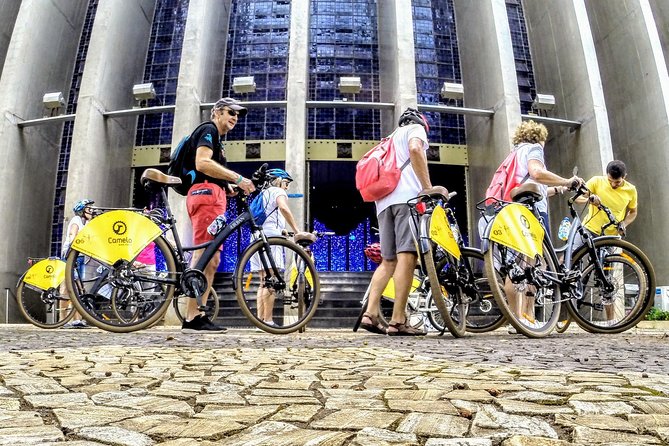
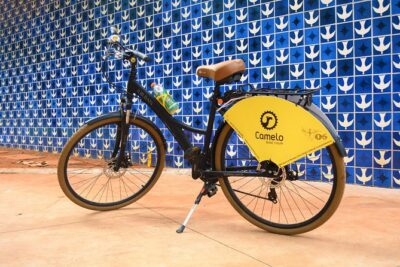
The meeting point is Camelo Bike Tour in the Brasil 21 business center in Asa Sul. From there, the first main stop is the Television Tower pilotis. You get about 30 minutes here, with no admission fee, and it is a useful opening view of Brasília’s central arrangement.
The nearby TV Tower Craft Fair adds a more informal note. This is a good early contrast: the tower belongs to the city’s planned monumental image, while the market reflects the practical, social side of the capital. You should use this first stop to settle onto the bike, listen to the route briefing, and ask for any adjustment before the ride gathers speed.
Bike fit is worth taking seriously. One rider praised the care taken to test the bicycles before departure, but found the choice less suitable for two shorter women. Another felt the bikes could be in better shape. Arrive ready to speak up about saddle height, reach, brakes, and comfort. A seven-hour ride magnifies small problems.
Clube do Choro and Brasília’s musical side
Clube do Choro is a short stop, about 20 minutes, but it adds welcome texture to a route otherwise dominated by architecture. The building is another Niemeyer project, designed as a concert hall for about 500 people. It also houses the Raphael Rabello Choro School.
The school teaches cavaquinho, mandolin, tambourine, guitar, saxophone, flute, accordion, harmonica, violin, and viola caipira. That list gives you a sense of the place’s role. This is not only a performance venue. It is part of Brasília’s working music culture, where students learn and practice Brazilian instrumental music.
The stage gained extra attention after Paul McCartney gave a surprise show there on November 28, 2023. The stop is brief, so it is not a concert visit, but your guide can place the building and its musical story within the wider city.
You also pass the Ulysses Guimarães Convention Center. It was designed originally by Sérgio Bernardes and can accommodate 9,400 people in a 54,000-square-meter complex. Five auditoriums and 13 modular meeting rooms make it a useful reminder that Brasília is not only a political capital and architectural exhibit. It is also a conference city with a large service economy.
Parque da Cidade and Renato Russo Hall
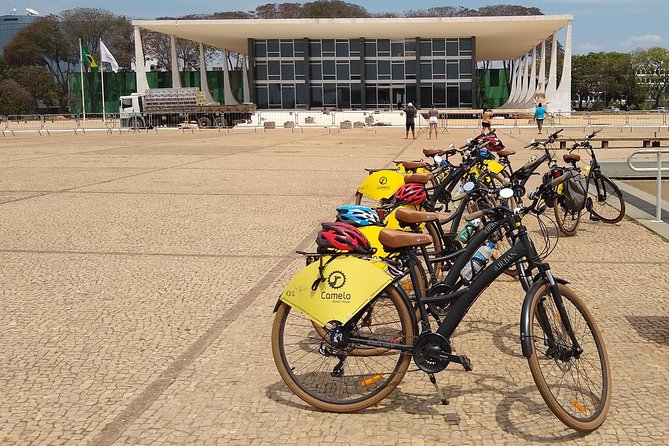
The ride continues to Parque da Cidade Sarah Kubitschek, described as one of the largest urban parks in the world. You have about 25 minutes here, followed by a pass near Renato Russo Hall.
This is one of the route’s important changes of mood. Government buildings ask you to look upward and outward. The park asks you to notice how residents use open space. You get a break from the formal center and a chance to appreciate the planned city’s recreational side.
The nearby Renato Russo cultural space adds another local connection. Later in the route, you pass the Espaço Cultural Renato Russo at 508 South, which includes rooms, galleries, and two theaters, Teatro Galpão and Teatro de Bolso. These brief visits do not provide time for a full cultural program, but they show that Brasília’s creative life is spread through its sectors rather than limited to one museum district.
Same city, a completely different kind of day:
- Rio de Janeiro: 6-Stop Highlights of Rio with Lunch
★ 4.4 · 5,157 reviews - Christ the Redeemer Entry Ticket by Corcovado Train
★ 4.4 · 4,476 reviews - Rio de Janeiro: Rocinha Favela Walking Tour with Local Guide
★ 4.8 · 3,052 reviews - Rio de Janeiro: Sugarloaf Cable Car Official Ticket
★ 4.6 · 2,873 reviews
SQS 308, the model superquadra
The 45-minute stop at SQS 308 is one of the strongest parts of the ride. This superquadra was chosen as Brasília’s model residential court. Lúcio Costa designed it, Burle Marx handled its urbanism and landscaping, and Banco do Brasil built it. It opened on February 19, 1962.
Here you can see the residential scale in practical form. Buildings sit within planned open areas, with local services, schools, leisure spaces, and pedestrian movement arranged as part of the whole. The point is not only that the blocks look different from a conventional neighborhood. It is that the design tries to make housing, greenery, daily errands, and community space work together.
A guide can explain this far better on site than a quick photo stop can. Pay attention to the relationship between the buildings and the ground around them. The open areas are central to Costa’s plan, not leftover spaces between structures.
The route also visits Superquadra Sul 302 for about 15 minutes. It is not the first model superquadra, but its arrangement is similar, with building projections, local commercial lots, schools, and leisure areas. Seeing both 308 and 302 helps you compare the idea rather than treating one block as an isolated curiosity.
Igrejinha and Athos Bulcão’s tiles
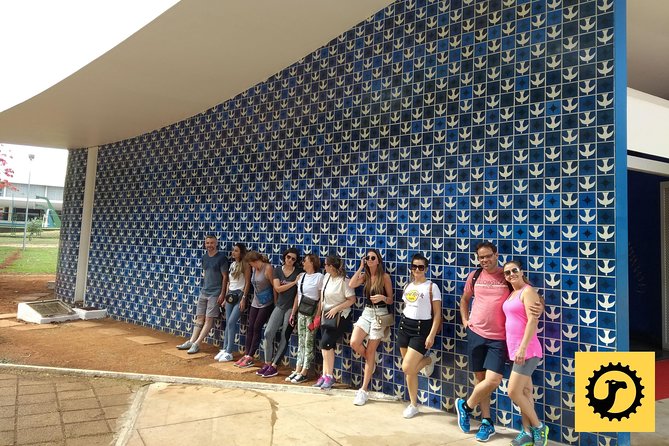
Nossa Senhora de Fátima Church, known as Igrejinha, receives about 20 minutes. Inaugurated in June 1958, it was the first church in Brasília’s residential sector. It was built at Dona Sarah Kubitschek’s request after her daughter recovered from an illness.
The church is especially memorable for its exterior tiles by Athos Bulcão. Stylized images of the Dove of the Divine and the Star of the Nativity cover the outside walls. The church is smaller and more intimate than the great civic structures, making it a helpful stop for understanding how modern design entered ordinary neighborhood life.
I like this part of the route because it shows that Brasília’s visual language was not reserved for ministries and courts. The city’s modernism appears in places of worship, housing, parks, and local streets too.
Itamaraty, the Sanctuary, and the Cathedral
The route turns back toward major landmarks with short stops at Palácio Itamaraty, the Sanctuary of Saint John Bosco, and the Metropolitan Cathedral.
You have about 10 minutes at Itamaraty, the Ministry of Foreign Affairs headquarters, also called the Palácio dos Arcos. It is one of Niemeyer’s best-known works. The short time is enough to take in the exterior and hear why the building matters, but not enough for a detailed interior visit.
The Sanctuary of Saint John Bosco gets about 15 minutes. It honors Brasília’s patron saint and is known for its striking interior atmosphere. The tour data does not promise an interior visit or a service, so think of this as a guided architectural stop rather than a scheduled religious program.
The Metropolitan Cathedral also receives about 15 minutes. Designed by Niemeyer, it marked an important moment in modern architecture and in Brasília’s development. Its unusual form makes it one of the city’s essential stops, yet seeing it by bicycle adds a useful sense of scale. You approach it as part of the city plan, not just as a detached building reached by a tour bus.
You also pass Rua das Farmácias, where pharmacies dominate the shops because of the nearby South Medical and Hospital Sector. It is a small detail, but it helps you read Brasília as a functioning city rather than a collection of official monuments.
Commercial sectors and the city’s everyday pulse

The ride reaches Praça do Povo in the South Commercial Sector. Renovated in 2021, the square won a regional award from the Brazilian Institute of Architects in the Urbanism, Planning and Cities category. Its new layout supports skateboarding, shows, and kiosk areas.
You get about 30 minutes in the South Commercial Sector itself. During weekdays, this is one of the city’s main pedestrian zones, helped by its proximity to the bus station and the Esplanade of Ministries. The area brings together services, institutions, workers, and different parts of Brasília’s population.
This section may be more revealing than another grand façade. The commercial sector shows how the planned city handles ordinary movement and social contact. Its spaces have been undergoing renewal, and the route lets you see both the older urban structure and newer efforts to make it more useful.
The National Museum of the Republic receives only about five minutes, so expect an exterior look rather than a museum visit. The building was part of the original Brasília plan, with the cultural complex commissioned from Niemeyer in the 1970s.
You also pass the Sarah Hospitals Network’s first unit. This rehabilitation center was designed by João da Gama Filgueiras Lima, known as Lelé. Its design uses natural light, ventilation, colorful open areas, and flexible construction to make long stays less institutional. The main building uses vierendeel beams, terraces, and double-height spaces around patient areas.
That stop gives the tour another valuable angle. Brasília’s architecture is not only about iconic government buildings. Lelé’s work shows how design can address care, construction methods, and the daily needs of patients.
The Three Powers Square and Lúcio Costa’s model
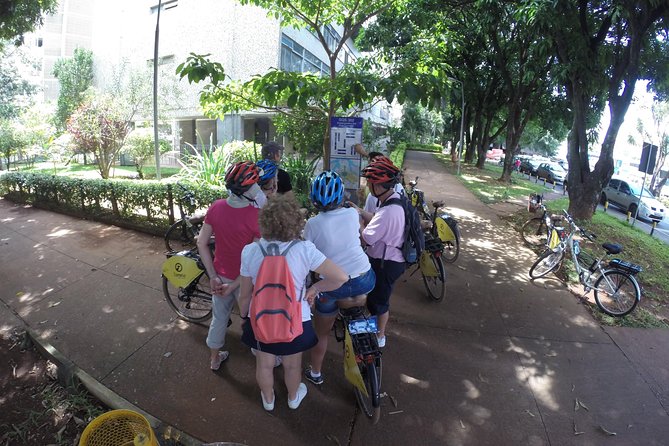
Praça dos Três Poderes is the civic heart of the route. Inaugurated on April 21, 1960, the same day Brasília became Brazil’s federal capital, it was created by Lúcio Costa and designed by Oscar Niemeyer.
The square brings together the country’s three branches of government. The Supreme Federal Court sits at one vertex, opposite the Planalto Palace, while the National Congress forms a major visual marker at the beginning of the Ministries Esplanade. The route also passes the place where the President of the Republic works.
You have about 20 minutes in the square, followed by a 15-minute stop at Espaço Lúcio Costa. The latter is an underground building opened in 1992 for Lúcio Costa’s 90th birthday. Inside are a model of Brasília and a tactile model of the Plano Piloto.
This is one of the most useful stops for making sense of the capital. The model turns an abstract city plan into something you can understand at a glance. If you have already seen the superquadras, parks, ministries, and civic spaces, the model ties them together.
The Supreme Federal Court gets about five minutes, and the National Congress is seen as part of the civic route. You should keep your expectations in check: this is an architectural and urban tour, not a full visit inside every government building. The reward is the overall composition and the guide’s explanation of how the parts relate.
National Theater, Pantheon, and Burle Marx Garden
The Claudio Santoro National Theater is another Niemeyer work, with about 10 minutes for the stop. You pass the National Library, Cultura Inglesa, Aliança Francesa, Praça 21 de Abril, and the Renato Russo cultural space at 508 South. These places broaden the cultural picture beyond the museum and cathedral circuit.
The Pantheon of the Fatherland receives about five minutes. The National Congress and Ministries Esplanade follow, bringing the ride back into the large civic spaces that define Brasília’s public image.
The final listed stop is Jardim Burle Marx, with about 10 minutes. Burle Marx’s role already appeared at SQS 308, so this garden gives you another chance to notice how planting, paths, and open ground shape the experience of the planned city.
The tour then returns to the Camelo Bike Tour meeting point. At roughly seven hours, this is not a quick orientation ride. It is a full-day program with a broad route and many short stops.
Price, equipment, and pace
The price is $97.03 per person. That is a significant spend for a bike tour, but the value depends on how you like to see cities. You are paying for a full day of guided movement across a very spread-out capital, not simply for bicycle rental and a few monument photos.
The bike, two 500-milliliter bottles of mineral water, and a helmet are included. Lunch is not, so plan for the food break as part of your day. The supplied details do not specify a set restaurant or meal stop, which means you should confirm how the schedule handles lunch before setting out.
The group limit is 15 people. That is small enough for a guide to control crossings and keep the group together, yet large enough that the pace may not feel private. Daniel has been praised for managing crossings and traffic lights, helping riders, explaining the city in an entertaining way, and taking photos. Romain has been noted for his architecture and history explanations. Larissa and Rui are also named guides associated with particularly enjoyable rides.
Helmets are available, though their use is not mandatory in Brazil. Use one. On a long ride through a capital with broad roads and changing light, the small comfort is worth it.
One practical point deserves attention: a past afternoon ride extended into evening without lights being prepared. The operator has stated that lights are available for nighttime tours, but I would still confirm the equipment if your booking begins late in the day. The ride can run long enough for lighting conditions to change.
Children from about four to 10 or 12 can use an articulated tandem passenger trailer or bike, but you must ask in advance. Most people can participate, and the meeting point is near public transportation.
Who should book this Brasília bike tour?
I would choose this tour if you want architecture explained in relation to daily life. It suits riders who are comfortable spending most of a day on a bicycle and who would rather see a model superquadra, a commercial sector, and a music school alongside the Cathedral and Congress.
It is less suitable if you want leisurely interior visits at museums and government buildings. The schedule moves widely, and many stops last only five to 20 minutes. You should also think carefully about bike fit if you are short, have limited cycling experience, or dislike long outings.
The experience has earned a full five-star average from 49 ratings, with every rating recommending it. The strongest praise centers on the guides, the broad view of Brasília, the careful handling of crossings, and the chance to reach spaces that would be difficult by car or on foot. The equipment concerns are real but manageable if you request a suitable bike before departure and check it carefully at the start.
Should you book it?
Book this tour if Brasília’s architecture and urban planning are your main interests, and if you want to understand the city beyond its postcard buildings. The combination of SQS 308, Clube do Choro, Parque da Cidade, the commercial sectors, and Praça dos Três Poderes gives you a fuller picture than a short monument circuit.
At $97.03, it offers good value for a long, guided city overview, provided the bike fits and you are prepared for the seven-hour pace. Ask in advance about bike sizes, the child trailer if needed, lunch timing, and lights if the ride may extend into evening. If those details work for you, this is one of the more thoughtful ways to read Brasília.
FAQ
How long does the Bike Tour of the 4 Scales of Lucio last?
The tour lasts approximately seven hours and ends back at the Camelo Bike Tour meeting point.
How much does the tour cost?
The listed price is $97.03 per person.
What is included in the tour price?
The price includes use of a bicycle, two 500-milliliter bottles of mineral water, and a helmet. Helmet use is not mandatory in Brazil.
Is lunch included?
No. Lunch at the restaurant is not included.
Where does the tour start?
The meeting point is Camelo Bike Tour Brasília, SHS Quadra 06 Conjunto A, Bloco A, Loja 17, Centro Empresarial Brasil 21, Asa Sul, Brasília, DF, 70316-102, Brazil.
What is the maximum group size?
The tour has a maximum of 15 participants.
Can children join the bike tour?
Children from about four to 10 or 12 years old can use an articulated tandem passenger trailer or bike. You need to ask about this in advance.
Can I cancel for a full refund?
You can cancel at least 24 hours before the start time for a full refund. Cancellations or changes made less than 24 hours before the start are not refunded or accepted. If poor weather causes the tour to be canceled, you will be offered another date or a full refund.
Just added around Brazil
- Vidigal Favela Tour★ 4.4 · 26 reviews
- Hang gliding flight in Rio de Janeiro★ 5.0 · 6 reviews
- Paraty Historical City Walking Tour★ 4.1 · 8 reviews
- Rio de Janeiro: Zip Lining and Canopy Tree Tour★ 3.3 · 6 reviews
- Walking Tour of São Luís do Maranhão★ 4.4 · 14 reviews
- Rio de Janeiro: Attend a Vasco da Gama game with local guide★ 4.8 · 9 reviews
- Unforgettable Boat Party★ 5.0 · 3 reviews
- Trindade Day Trip: Nature and Sea Adventure from Paraty★ 4.6 · 5 reviews
Cycling Tours, compared.
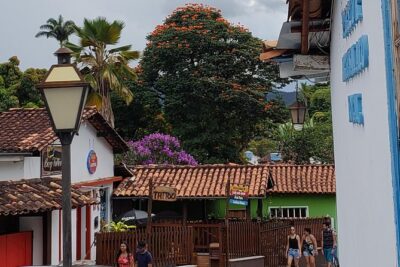
Pirenópolis, the charming baroque city inaugurated in 1723 in the gold cycle
Read our review →Browse the lists this tour appears in